
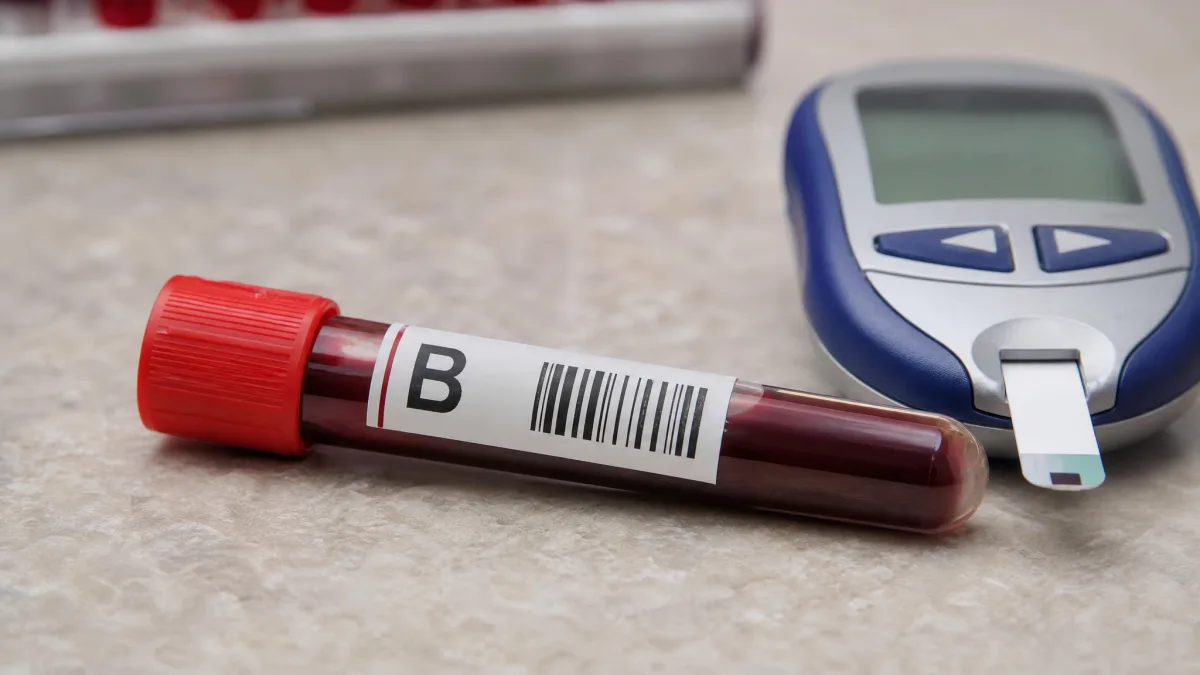
Blood group B carries modestly higher odds of type 2 diabetes than other blood groups, and it is the only blood-group link that held up under the strictest check in a large review. That matters because blood type is one of the few things you may already know about yourself, from a donor card, a transfusion record or a pregnancy test.
Seeing a B in that spot can make a headline feel personal. So here is the scale of it: the review, published in BMC Medicine on May 20, 2024, pooled 51 systematic reviews covering 270 blood-group and health associations, and only this one link reached the top grade of convincing.
The number attached to it is an odds ratio of 1.28, meaning about 28 percent higher odds for group B than for everyone else. It is a small signal pooled across many studies, not a forecast about any one person, and it does not show that blood type causes diabetes.
Weigh it next to what you can actually change. Diet, activity and weight carry larger risks, and the study did not work out why blood group B would matter at all. By the end, you should know how much of your attention that B deserves, and which evidence is still missing.
Only Blood Type B Cleared the Bar

Yes, but only one link survived close scrutiny, and it concerns blood type B and type 2 diabetes. The finding comes from a review published in BMC Medicine on May 20, 2024.
The work is a synthesis, not fresh data. The team pooled 51 systematic reviews with meta-analyses, which together covered 270 associations between blood groups and health outcomes.
Of all 270, just one reached the top grade: the link between having type B blood and type 2 diabetes, set against everyone who does not have B.
Fang-Hua Liu, an epidemiologist at Shengjing Hospital of China Medical University, described the process plainly. "We redid every link we looked at, and just one came out as convincing proof of a connection: blood group B versus non-B, in relation to type 2 diabetes mellitus risk."
Most readers already know where they sit in that comparison. A donor card, a transfusion record or a pregnancy test result usually carries the letter, so someone with B can place themselves in the first group without any further testing.
That is what the top grade offers: one association solid enough to take seriously. It is not a personal risk estimate, and it does not turn the letter B into a forecast.
| Risk factor | Reported size | What the figure means |
|---|---|---|
| Blood group B (vs non-B) | 28% higher odds | Summary odds ratio of 1.28 from pooled observational studies; no baseline risk given |
| 50 g processed meat per day | 37% higher risk | Comparison figure cited by the news page; not a like-for-like experiment |
| Sedentary lifestyle | 112% higher risk | Comparison figure cited by the news page; not a like-for-like experiment |
The Link Is Consistent but Modest

The link is real but small. Pooled across the studies, people with blood group B had 1.28 times the odds of type 2 diabetes as people in non-B groups, with a confidence interval running from 1.17 to 1.40. That rests on 6,870 cases.
An odds ratio of 1.28 means 28 percent higher odds, not 28 percent more people developing diabetes. The difference matters: the review does not supply a baseline risk, so nobody can work out how many extra cases that gap would mean for them personally.
The result held together well. Consistency between studies scored an I2 of 13 percent, a low-heterogeneity figure, and the 95 percent prediction intervals excluded the null. In plain terms, a future study would still be expected to point the same way.
One caveat stays attached. The largest study in the pool was not more conservative than the summary estimate, a quiet check on whether small studies inflated the result.
So the pooled number rules out no effect at all. What it leaves is a small relative difference across thousands of cases, which is not the same thing as a personal certainty.
The B–diabetes finding in four numbers
What the review actually reported
Source: umbrella review in BMC Medicine, 2024
28 Percent Higher Odds Is Small Next to Lifestyle

Set the 1.28 odds ratio against habits a person can change, and the size of the blood-group signal comes into view.
For scale, the news page cites two familiar risks: 37 percent higher risk for 50 grams of processed meat a day, and 112 percent for a sedentary lifestyle. Both are larger than the 28 percent pooled odds attached to blood group B.
The figures are not strictly the same kind of measurement. The 28 percent is an odds ratio drawn from pooled observational studies, while the lifestyle numbers serve as context, not as a head-to-head experiment.
The news page draws its own conclusion: blood type on its own will not decide whether someone develops diabetes, because diet, activity and weight carry far more of the story.
There is also a gap in the arithmetic. No baseline risk is supplied, so a reader with B cannot work out how many extra cases 1.28 amounts to for them personally. The same figure lands differently on someone with several other risk factors than on someone with none.
The comparison still does useful work. It tells someone with B where to put their effort, and it makes clear that the number is a reason to look at the whole picture rather than a verdict on one label.
⚠️ COMMON MISTAKE
Don't treat 1.28 as a diagnosis
An odds ratio of 1.28 is a modest statistical signal, not a prediction about your body. It cannot tell you whether you will develop type 2 diabetes, and it does not outweigh the risks you can change.
The Study Cannot Show Cause

A comparison of pooled risks still leaves the bigger question open: whether blood group B causes type 2 diabetes or simply travels alongside something else that does.
The review can only report a pattern. It pooled observational studies, the kind that watch people rather than assign them to groups, so it cannot show that the blood group itself drives the risk. What it can show is that people with B were diagnosed somewhat more often than people without it.
The authors frame it carefully, calling the relationship potential and asking readers to interpret it with care. That wording is not caution for its own sake; it is what the evidence supports.
The review also left a large question untouched. It did not investigate any mechanism that might explain how a blood group could influence diabetes risk in the first place.
What this means for someone with type B on a donor card or a transfusion record: 1.28 does not say you are likely to develop diabetes. It is a modest pooled odds ratio, and blood type alone will not decide your risk.
Why Most Blood-Type Claims Failed

Only one of 270 links held up when the authors went back and checked. That one survivor stands out because most blood-group claims simply do not hold up.
Here is how strict the check was. The authors took apart 51 reviews that had already pooled studies. They regraded every single link. Of the 270 links, only one earned the top label, convincing. Another nine were statistically significant and reached only moderate certainty.
The reviews themselves often fell short. Of the 51, 32 were rated moderate on AMSTAR, a tool for judging how well a review is done. Another 11 were rated low.
The source review did better. It scored 9 out of 11 on that same tool, which lands it in the high-quality band.
Why so much weak ground? Fang-Hua Liu, an epidemiologist at Shengjing Hospital of China Medical University, points to the pile of past work. Plenty of systematic reviews with meta-analyses have come out examining how ABO and Rhesus blood groups line up with all sorts of health outcomes, Liu said.
But that pile has not settled anything. Liu said that, even now, whether these blood groups relate to people's health outcomes is still debated.
The authors were checking and regrading reviews that already existed. They did not run a new study of patients.
So the B link earns trust the hard way. It passed quality screening that almost every other claim failed. Not because blood-group claims are plentiful.
Earlier Work Linked Blood Groups to Disease

Blood groups interested researchers long before diabetes entered the picture, because the proteins and sugars that define a blood type sit on the surface of cells and shape how the body handles clotting and infection.
A 2000 study linked the ABO gene region to plasma von Willebrand factor, Factor VIII and aPTT, all measures of how readily blood clots. Later papers looked at HIV antibodies in 1991 and malaria in 2007.
The thread continued with a 2008 meta-analysis of vascular disease and a 2013 review of haemorrhage. Each one tied blood groups to a different part of the body's machinery.
None of that earlier work explains the diabetes finding. Those studies dealt with clotting, infections, malaria, vascular disease and bleeding, and not one of them traced a route from blood group B to type 2 diabetes.
That history does show why the question keeps returning. Blood type is easy to measure and hard to ignore, so researchers keep asking what it might mark.
What Would Prove the Link?

Following people forward in time is the test the pooled data cannot provide. A prospective study would recruit people with and without blood group B, record their blood type before any diagnosis, and then watch for years to see who develops type 2 diabetes. If that long watch turned up the same B-versus-non-B gap, the association would have survived a design that does not lean on memory or old records.
Six thousand eight hundred seventy cases sit behind the 1.28 figure, and none of them tells a reader how many of those cases are theirs. The odds ratio compares groups, not people. To turn it into extra cases for one person, researchers would need that person's starting risk – their age, weight, diet and activity folded in – and the pooled analysis supplies no such baseline.
The review also stopped short of asking why. It pooled observational studies, and that kind of data can spot patterns but cannot trace a pathway. The authors did not investigate what mechanism might tie blood group B to type 2 diabetes, so nothing in the paper says whether the blood group itself does anything or merely travels alongside something else.
That leaves the central gap: what biological mechanism could connect blood group B to type 2 diabetes, and has any study tested it directly?
A prospective cohort and a working mechanism are two different prizes. The first would firm up the pattern; the second would begin to explain it. Until both exist, the 1.28 odds ratio stands as a consistent signal still waiting for its reason.
Frequently Asked Questions
Does blood type B mean I will get type 2 diabetes?
No. The review found an association, not a cause. The summary odds ratio was 1.28, which is modest, and blood type alone will not decide your risk. Diet, activity and weight matter more.
How much does blood type B raise diabetes risk?
About 28 percent higher odds compared with non-B blood groups, based on 6,870 cases. That is an odds ratio of 1.28, not a 28 percent increase in the number of people who get diabetes.
Should I get tested for diabetes if I have type B blood?
Talk to your doctor about routine diabetes screening based on your age, weight and family history. Blood type alone is not a standard reason for extra testing, and the review does not recommend one.
Why did only one blood-group link hold up?
The authors rechecked 270 associations and found just one that reached their top grade of convincing evidence. Most reviews were rated moderate or low quality, and nine associations reached only moderate certainty under GRADE.
Is this finding new?
No. The review was published in BMC Medicine on May 20, 2024, and the news coverage followed later. The underlying data are observational studies, not a new experiment.
The Mechanism Question Still Has No Answer
The review settles one thing: group B is convincingly, if modestly, linked to type 2 diabetes in pooled observational data. It does not show that the blood group causes the disease, and it gives no personal risk estimate.
That B on the donor card still only places you in a comparison between B and non-B groups. Nobody has explained why the odds come out at 1.28.
So the open question is what biology could connect blood group B to type 2 diabetes, and whether any study has tested that connection directly. You can weigh the habits you control, and wait for the mechanism.
Sources
- One Blood Type Seems to Carry a Higher Risk of Type 2 Diabetes – ScienceAlert (news report) · 2026-10-18
- ABO and Rhesus blood groups and multiple health outcomes: an umbrella review of systematic reviews with meta-analyses of observational studies – BMC Medicine (peer-reviewed paper) · 2024-05-20