
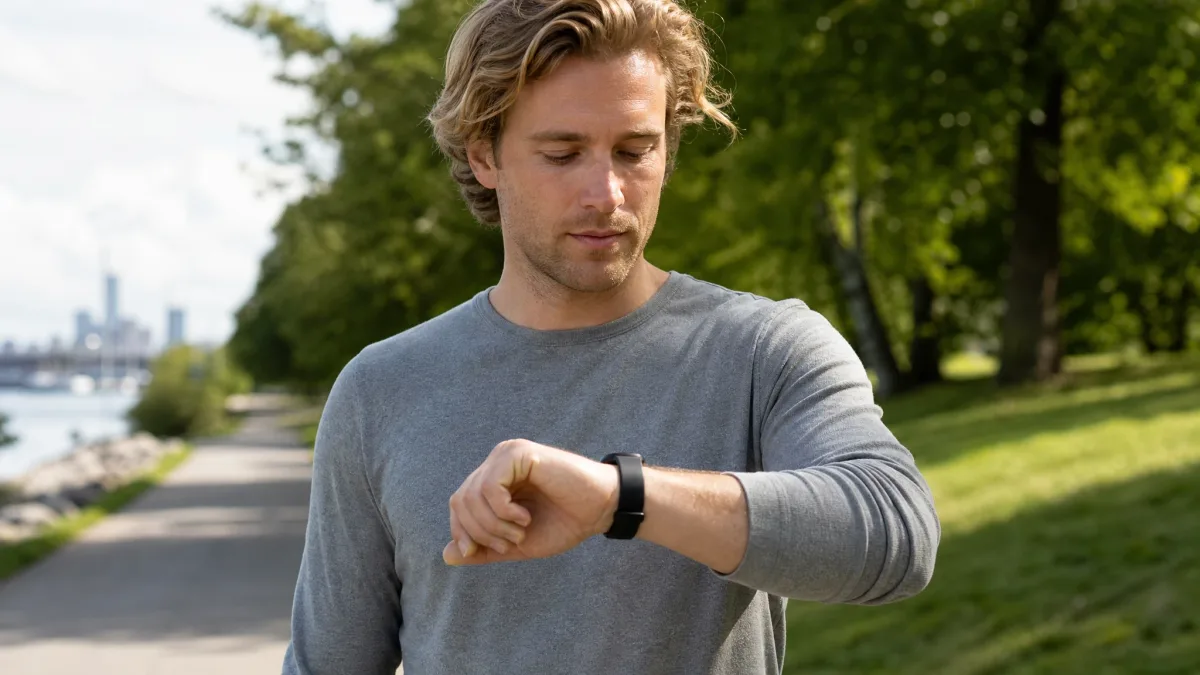
Your step tracker shows a number by mid-morning, and a headline promises that a 14-year study has found the daily count that sharpens focus, so you open it looking for a target.
There isn't one. The study did not test any daily target, and its authors describe the work as observational, so it cannot say how many steps a day protect thinking skills.
What it did find is smaller and steadier. In a large group of US adults, higher Fitbit step counts went with modestly better scores on sustained attention, reward choice and distraction control, with no threshold tested anywhere.
So the range the headline hints at comes from interpretation, not from the data. The link is modest; the direction is not settled, because people who think more clearly may simply stay more active.
Here is what the study measured, what it found, and the question it left open.
No Step Target Was Tested
No step target came out of this study, so there is no daily number to aim for.
The authors say so themselves. Olaoluwa Okusaga, a psychiatrist at Baylor College of Medicine, said the research was observational, so it wasn't set up to identify an ideal daily step count for brain health, in work published in Scientific Reports.
What they measured instead was simpler and messier. They counted steps with Fitbits over the years, then gave people thinking tests at the end. That is it. No group was told to walk a set number of steps, and no threshold was checked for scores to jump.
So any "range" in the headline is someone's interpretation, not a tested cutoff. The data contain no best daily count, because the researchers never compared one count against another on purpose.
For you, standing at the kitchen counter with a tracker on your wrist, that leaves a plain answer: the promised number is not in this paper. The activity it tracked was whatever people happened to do, and the thinking scores were grouped by how much they did, not by hitting a target.
The step question is not settled by this study. It is left where the authors put it: an open question they did not set out to answer.
What the 14-Year Study Tracked

The study followed US adults enrolled in the All of Us research program, a national effort to gather health data from a large and varied group of people. Their ages ran from 18 to 93, with an average of about 58.
Activity did not come from memory. Participants wore Fitbit trackers, so their steps were counted by a device rather than recalled in a questionnaire months later. That matters, because people are famously poor at estimating how much they move.
The thinking tests are the part that often gets missed. They were given once, starting in September 2023 and onward. The study did not follow anyone's thinking across the 14 years, so it cannot say whether scores rose, fell or held steady.
Not everyone had activity data for the whole stretch either. Some people wore the tracker for part of it and not the rest, so the researchers estimated each person's pattern from the measurements they had.
In other words, the 14 years belong to the step counts. The cognitive snapshots are single moments at the end, taken from people whose walking habits had to be pieced together.
The Attention and Reward-Choice Results

The people who moved more tended to score higher on three of the four thinking tests, and those adjusted gaps remained after the researchers took age, education, income, marital status and birthplace into account.
On sustained attention, the task that asks a person to stay focused on a boring, repeating signal, the link was modest: a beta of 0.31, with a 95% confidence interval of 0.18 to 0.44. Distraction control, which measures how well someone filters out competing cues, came in at 0.26 (0.17 to 0.35). Reward choice, where people pick between a small reward now and a bigger one later, came in smaller, at 0.05 (0.04 to 0.07). The pattern was consistent.
Put in points, the middle activity group scored an estimated 1.76 points higher on sustained attention than the least active group. The most active group scored 2.17 points higher. Modest numbers, not a leap.
The activity groups showed no meaningful difference in facial emotion recognition. That contrast is striking.
And when the researchers looked at how activity changed over time, those shifts were not significantly linked to cognitive performance. The association sat with overall activity levels, not with getting more active during the study.
What the 14-Year Study Found
The numbers behind the headline, without the step target
Source: All of Us Research Program analysis, published in Scientific Reports.
Blood Pressure Explains Only a Small Slice

A small slice of the step-to-score link might run through blood pressure, but only a small slice. When the researchers looked at the top number in a reading, systolic pressure, higher values went with slightly worse scores on the reward-choice test. The effect was tiny: a beta of -0.01, with a 95 percent confidence interval of -0.02 to -0.004.
That interval stays below zero, so the direction held in this group. It is still a sliver of a signal, the kind that shows up in a large sample and may be too small to notice in daily life. Picture the reward-choice test as a row of smaller-sooner versus larger-later offers; higher systolic pressure was linked to a faint nudge toward the impatient pick.
The bottom number, diastolic pressure, told a different story. Once age, education, income, marital status and birthplace were taken into account, it showed no meaningful tie to any of the four tests. Whatever the tests were picking up, the lower reading was not carrying it.
Then the researchers asked how much of the step-count link to reward choice blood pressure could statistically account for. The answer was about 5 percent. Picture a bar of 20 equal blocks; roughly one block belongs to blood pressure. The rest belongs to something else the study did not measure.
One line matters here. That 5 percent is a statistical bookkeeping figure, and it does not show that lowering blood pressure improves cognition. Treat it as a clue about where the link may run, not a lever to pull.
⚠️ COMMON MISTAKE
The 5 percent figure is not a treatment plan
It is tempting to read the blood pressure finding as a reason to lower your numbers for your brain. The study did not test that. It measured an association at one point in time, not the effect of changing pressure on later attention.
What This Evidence Cannot Show

Even with blood pressure factored in, nothing in this study shows that moving more causes better attention; the authors say so themselves.
Olaoluwa Okusaga, a psychiatrist at Baylor College of Medicine, said the results back a link between physical activity over the long term and cognitive performance later on, but they fall short of showing that activity is what produces sharper thinking. The study watched people, it did not assign anyone to a walking group or a sitting group. That design cannot rule out other explanations.
One is direction. People who already think and focus well may find it easier to stay active, so the link could run backward, or both ways at once. The researchers had no way to settle which came first.
Two more gaps: the analysis could not account for smoking or obesity, either of which could shape both activity and thinking. And the sample was mostly White, around two-thirds female, and close to all of them had attended at least some college, so the results may not hold for everyone.
The mechanisms often offered for a brain benefit, such as glucose metabolism, inflammation and the brain's adaptability, were not tested here at all. They remain plausible ideas rather than measured steps in this chain.
What the Study Shows vs. What It Cannot Show
What it shows
- Higher step counts were linked to modestly better sustained attention, reward choice and distraction control.
- The middle and most active groups scored higher than the least active group on three tests.
- Lower systolic pressure could account for about 5 percent of the link to reward choice.
What it cannot show
- That activity causes better attention or that a specific daily step count is optimal.
- Whether attention changed over the 14 years, since tests were given only once.
- That the small score differences would be noticeable in daily concentration or decisions.
Where It Touches an Ordinary Day

The skills these tests probe are the ones a normal day keeps calling on, even though no step target comes with them: focus at your desk, holding back an impulse, and sticking with a goal that pays off later.
Okusaga gave everyday instances: staying focused on tasks at work, resisting rash choices, and sticking with long-range objectives like putting money aside or keeping to a health regimen. Those are the everyday faces of sustained attention, reward choice and distraction control.
A daily step count already sits on many wrists, which is why the setup feels familiar. The difference is that a wearable reports a number, while the study used step counts as a measure and then tested thinking separately.
The tests themselves were lab tasks, not your Tuesday afternoon. The researchers did not measure real-world concentration or financial decisions directly. So the relevance is to the tested skills, not to a proven step target and not to a measured life outcome.
Read the tracker as a record you already keep. It does not tell you how many steps to take for a sharper mind, because this study never set that bar.
The Direction of the Link Is Still Open

Attention could protect activity, or activity could protect attention. This study cannot say which way the arrow points.
The authors put the second reading plainly: the results back a link between long-term physical activity and cognitive performance later in life, yet they fall short of showing that activity is what produces sharper thinking. Olaoluwa Okusaga, a psychiatrist at Baylor College of Medicine, is the lead author. People who already concentrate well may find it easier to keep moving, and that would look the same in the data.
Nobody in the study took the tests twice. Everyone's thinking was measured once, from September 2023 onward, so the researchers saw a single snapshot of each person's attention sitting beside years of step counts. They could not watch attention rise or fall as activity rose or fell.
That is what a later round of testing would need to do. The stronger test is not whether active people score higher at one sitting. It is whether the same person's attention shifts as their step count shifts over the years.
Then there is the question of size. The adjusted gap between the least and most active groups on sustained attention came to 2.17 points on a test whose full scale the study does not put into daily terms. Whether a gap like that shows up as holding a train of thought at your desk, or waiting one more day before an impulse buy, stays open. The tests measured the skills, not the moments, and two plausible directions still fit the numbers.
Until someone is tested repeatedly, attention and activity look like two things that travel together in this study. Which one leads is not settled.
Frequently Asked Questions
Did the study find an optimal number of daily steps?
No. The authors state that the study was observational and was not designed to determine an optimal number of daily steps for cognitive health. It compared higher and lower activity levels, not people who hit a specific daily target.
What cognitive skills did the study measure?
The researchers used four tests: sustained attention (Grad-CPT), reward choice (DD-Task), distraction control (Flanker-Task) and facial emotion recognition. The first three showed significant links with activity; facial emotion recognition did not differ significantly between activity groups.
How large were the differences in attention scores?
After adjustment, sustained-attention scores were an estimated 1.76 points higher in the middle activity group and 2.17 points higher in the most active group than in the least active group. The study notes that everyday behavior such as concentration at work was not directly measured, so the practical size of these differences is unknown.
Could blood pressure explain the link between steps and attention?
Only partly. Lower systolic pressure could statistically account for about 5 percent of the association between step counts and reward-choice scores. Diastolic pressure was not significantly associated with any of the four tests after adjustment.
Was the study representative of the US population?
Not fully. The sample was largely White, about two-thirds women, and nearly all had at least some college education. The analysis also could not account for smoking or obesity, which limits how broadly the findings apply.
Does moving more cause better attention?
The study cannot say. Its authors note that the findings do not prove physical activity causes better cognition. People's existing thinking abilities could influence how active they stayed, and the direction of the link remains unresolved.
The Step Count Can Wait; the Direction Question Cannot
The verdict is plain: no daily step count was tested, the study reports modest associations, and it cannot show that activity causes sharper attention.
The tracker on your wrist still counts steps, and any range in the headline is someone's reading of the data, not a threshold the researchers set.
What remains open is direction. Attention could protect activity, or activity could protect attention.
Settling that would take testing the same people again and again over years, to see attention shift as their activity shifts, and whether a small score gap shows up in ordinary concentration. Until then, the number on your wrist is just a number, and the choice of what to do with it is yours.
Sources
- How Many Steps a Day Does It Take to Sharpen Your Attention? A 14-Year Study Hints at The Range – ScienceAlert (news report) · 2026-10-19
- Physical activity and blood pressure as predictors of cognitive function in the all of us research program – Scientific Reports (peer-reviewed paper) · 2026-10-11