
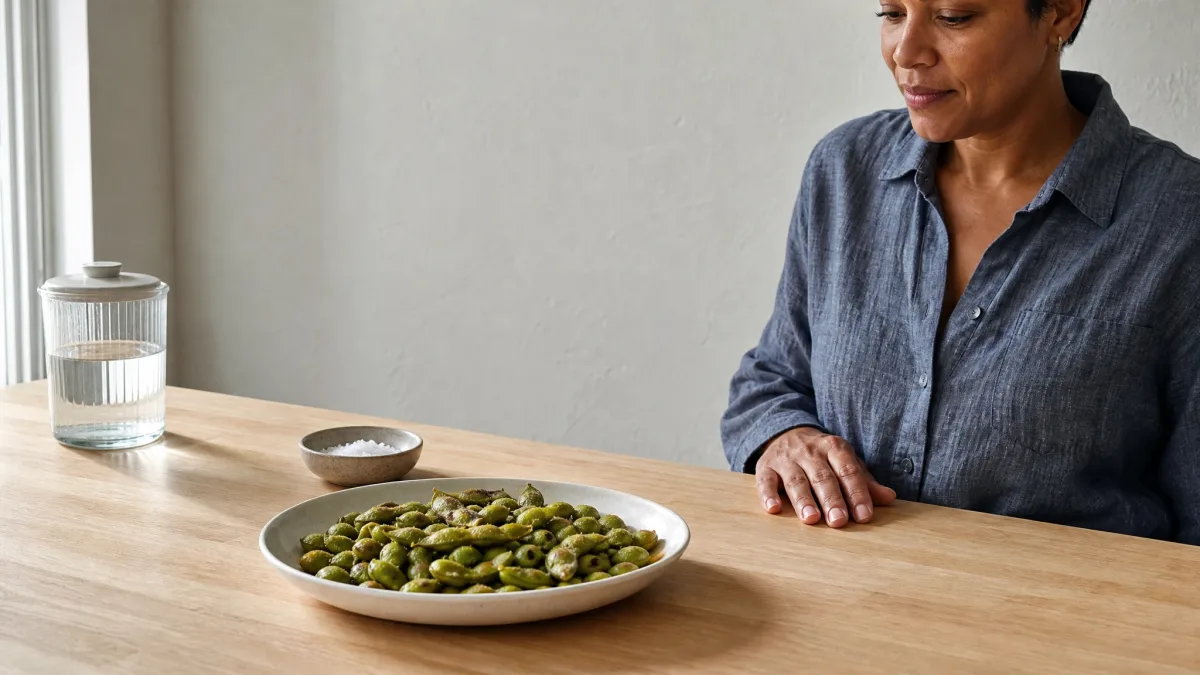
For years the warning about salt has been the same: too much of it raises blood pressure. What has been less clear is whether the brain takes damage from the same habit, and whether anything in a normal diet can soften it – a question this mouse study only begins to probe.
A paper in Neurochemistry International offers a mouse-sized piece of an answer. The work, published online May 14, 2026, and in Volume 197 on July 1, 2026, tested a soy-derived compound called LPC70 in mice eating a high-salt diet.
The mice on salt developed higher blood pressure and did worse on two behavioral tests. Adding LPC70 to their food reduced the pressure climb and improved those scores, with molecular changes tracked in the kidney and in a brain region tied to thinking and memory.
Here is what was actually measured, in which tissue, and how far that sits from a claim about your brain.
| Tissue or signal | On the high-salt diet | With LPC70 added |
|---|---|---|
| Blood pressure | Rose | Rise was reduced |
| Social interaction | Less social with each other | Scores improved |
| Object recognition | Trouble recognizing seen objects | Scores improved |
| Kidney COX-2 and EP3 | Raised | Salt-related increases reduced |
| Prefrontal cortex DP1 | Lowered | Restored |
| Prefrontal cortex DP2 | Unchanged | Unchanged |
| Circulating arachidonic acid | Lower | Not reported |
What LPC70 is and why salt matters

LPC70 is a fat fraction taken from soy, and its name is a recipe card, not a brand. More than 70 percent of its phospholipids – the fat molecules that make up cell membranes – are lysophosphatidylcholine.
That is the whole definition. Nothing in a percentage of membrane fat promises anything about a brain.
The reason anyone asked is salt. Eating too much of it is already a public-health worry because of its association with high blood pressure. The brain question grows out of that blood-pressure problem; it is not a separate fear.
So the researchers pitched LPC70 carefully. They describe it as a possible functional food ingredient of the future – something that might soften some of the fallout from a salty diet. It is not a drug. It is not a treatment.
One constraint sits above everything else in this paper, and it should be fixed in your mind before a single result arrives: every experiment was done in mice. That single fact shapes how every number in the sections ahead has to be read.
Read the label again and notice what it does not say. A soy fat, more than 70 percent one phospholipid, tested in animals – the word shield has not appeared yet, and the definition alone cannot produce it.
What changed in the salt-fed mice

Fed a high-salt diet, the mice developed raised blood pressure. That is the oldest salt result there is, and here it served as the starting injury the rest of the study was built around.
The same animals drifted apart socially, spending less time interacting with their cage mates. They also struggled on an object-recognition test – shown an object they had met before, they did not act as if they knew it. Both scores moved in the same direction as the pressure.
The change was narrow. Overall movement and anxiety-like behavior did not change substantially, so these were not simply sicker or calmer animals. Something more specific may have slipped.
Then LPC70 went into the diet. The rise in blood pressure came out smaller, and the social interaction and object recognition scores improved – the compound nudged both readings back the other way.
That is the core result: one pressure measurement and two test scores, all in mice. Nowhere in it is a measure of brain tissue kept safe, and nowhere in it is a person.
The salt-and-soy experiment by the numbers
Four figures that frame the result
Figures from the Neurochemistry International paper, published July 1, 2026.
Kidney and brain responded in different directions

The chemical trail LPC70 left runs in different directions depending on the organ. In the kidney, the high-salt diet raised levels of COX-2, an enzyme in prostaglandin production, and of EP3, a receptor for the prostaglandin PGE2. LPC70 reduced these salt-related increases [S1]. There, the compound pushed back against signals that salt had raised.
The prefrontal cortex, a brain region involved in thinking, memory and social behavior, behaved differently. Salt lowered levels of DP1, a receptor for the prostaglandin PGD2 that is linked to protective, anti-inflammatory signaling. LPC70 restored DP1, while DP2, a receptor tied to potentially harmful effects on nerve cells, stayed unchanged [S1]. There, the compound refilled something salt had drained.
One more piece sits underneath both. Arachidonic acid, the fatty acid the body builds prostaglandins from, was lower in the blood on the high-salt diet in these mice [S1]. The authors read that as the body putting the fatty acid it had to more efficient use.
Prof. Mouri described the aim this way: the team set out to clarify how LPC70 coordinates shifts in PG signaling among different organ systems [S1].
Two tissues, two directions, one shared raw material. A phrase like protecting the brain cannot carry a result shaped like that.
⚠️ COMMON MISTAKE
One word can hide a split result
It is easy to read 'protects the brain' and picture a uniform shield. The measured changes went opposite ways in kidney and cortex, so the summary word covers a mixed set of signals.
What these mouse results cannot tell us

The work was done in mice, and the results say nothing yet about people. The authors say so themselves and call for clinical studies [S1].
That matters because a mouse with a restored receptor is not a person whose memory holds. A test score in an animal may not mean that a human brain is guarded against salt.
There is a second gap. LPC70 was tied to shifts in prostaglandin signaling and to better test scores, but the paper never shows the signaling caused the gains [S1]. Both moved in the same animals at the same time, and nothing separated them.
Then there is who paid. The research was funded in part by Tsuji Oil Mills Co., a company that makes the ingredient [S1]. No other lab has repeated the work, and the paper has not yet been cited [S3].
It ran in Neurochemistry International, online May 14, 2026, and in Volume 197 on July 1, 2026 [S1, S3].
The authors keep their own claim small. They call the compound a possible future food ingredient, not a treatment [S1].
So what sits under the headline is mouse tissue and mouse behavior, one funder, and no second group checking the result. The distance from that to a human brain is the whole distance the headline crossed.
How prostaglandins got tied to salt
The link between salt, prostaglandins and the brain was not built in one paper. Separate labs stacked the pieces over years, each in its own system.
Earlier work in animals found prostaglandin D2 in nervous-system tissue. So the molecule was known to live in the nervous system long ago.
Earlier lab work on cells showed lysophosphatidylcholine can trigger release of arachidonic acid [S3]. That is the fatty acid prostaglandins are made from. The soy lipid had a documented route into the pathway.
Later came the salt link. Mice missing the prostaglandin EP2 receptor developed high blood pressure that depended on salt, and had fewer offspring [S3]. A receptor was now tied directly to how salt raises pressure.
Other work linked the PGD2 receptor DP1 to nerve-cell protection, including in stroke and in young and old mice [S3]. One study found that PGD2 acting through DP1 eased anxiety in mice [S3].
A study of soy lipids reached people, but with a different mix and a different target: phosphatidylserine plus phosphatidic acid, tested for effects on memory and mood in older patients with Alzheimer's disease and dementia [S3].
Read the list closely and one thing stands out. Each piece was measured in its own setting, and not one of them tested LPC70 against a high-salt diet.
What the headline claim leaves out

The word "shield" was added later, and it is a word about a person. Nothing in the paper puts a shield around a human brain.
The paper proposes a mechanism for the compound's effects [S1].
The gains are scores on two tests, in animals [S1]. They are not demonstrated protection of a human brain.
The receptors also do not move as one. In the kidney, salt raised COX-2 and the PGE2 receptor EP3, and LPC70 pushed those increases back down [S1]. In the prefrontal cortex, salt lowered the PGD2 receptor DP1, and LPC70 filled it back in [S1]. One tissue had signals cut; the other had one refilled.
A single word like "protecting the brain" cannot hold a result shaped like that. It hides the different directions and the different organs.
The funding sits outside the headline too. The company that makes the ingredient took part in the research [S1]. A reader of the headline would never guess that.
Do the signaling changes cause the memory gains?
Nothing in the paper shows that the receptor shifts did the work. The signaling changes and the better scores came from the same mice, in the same study, and were never pulled apart.
So the order of events stays unknown. It is possible that LPC70 refilled the brain receptor, and the mice then did better on the tests. It is equally possible the two things simply traveled together, with no cause running between them.
Prof. Mouri describes the aim in the paper: the goal was to clarify how LPC70 coordinates shifts in PG signaling among different organ systems. That is a map of the pathway, not a test of which step fixes memory.
One bigger gap sits under all of it. No one has fed LPC70 to people on a high-salt diet, so whether the same shifts would happen in a human brain is untested. The dose a person would need is not set either, and the paper does not say.
Duration is just as open. The mice were studied for a set stretch, and the paper does not report how long any gain lasts, or whether it fades once the compound stops. It also does not say if the compound has to stay in the diet to keep working.
Mouri places the work as a first step: the findings clarify how LPC70 functions in PG signaling and provide a foundation for later clinical studies and dietary approaches meant to lessen cognitive decline tied to hypertension and support healthy aging worldwide.
So the question travels forward to the next study, handed on rather than answered. That may not be a flaw in the design; it is what mouse work at this stage can settle and what it leaves for later.
Frequently Asked Questions
Does this mean I should eat more soy to protect my brain from salt?
No. The study tested a specific soy fraction called LPC70 in mice, not ordinary soy foods in people. No human dose or dietary change has been tested here, and the authors describe the compound as a possible future food ingredient, not a treatment.
Was the soy compound given to people at any point?
No. All experiments were in mice. The paper calls for clinical studies, which means the human work has not been done yet.
Which brain region did the study look at?
The prefrontal cortex, a region involved in thinking, memory and social behavior. In that area, excess salt lowered levels of the PGD2 receptor DP1, which is linked to protective signaling, and LPC70 restored them. Another receptor, DP2, was unchanged.
Could salt really affect memory?
In these mice, a high-salt diet raised blood pressure and the animals did worse on social interaction and object recognition tests. Whether the same happens in people is not established by this study. High salt intake is already a public-health concern because of its link to hypertension.
Who funded the research?
The research was funded in part by Tsuji Oil Mills Co., Ltd., the company that develops naturally derived food ingredients and is named in the paper's collaboration. No independent replication is reported, and the paper has not yet been cited by other published work.
Where and when was the study published?
The paper appeared online on May 14, 2026, and in Volume 197 of Neurochemistry International on July 1, 2026. The source does not report an independent replication.
The Causal Question the Mouse Data Cannot Settle
Here is the verdict, plainly. The paper is a specific, mechanistic, mouse-sized lead about a soy fat and salt. It is not support for buying the ingredient, slipping it into a parent's food, or thinking differently about anyone's salt intake.
The shield in the headline turns out to be a receptor restored in mouse prefrontal cortex, two test scores that improved, and a blood-pressure rise that eased.
It shows the prostaglandin shifts and the better scores arrived together, in the same animals, in one laboratory funded in part by the ingredient's developer.
So the question left over is causal, and it stays open: did the signaling cause the gains, and would any of it happen in people, at what dose, for how long? Nothing in this paper says, and the next study is what has to answer it before the warning about salt changes shape.
Sources
- Scientists discover a natural compound that could protect the brain from too much salt – ScienceDaily (news report) · 2026-10-18
- Soy lysolecithin attenuates hypertension and behavioral impairments in mice fed a high-salt diet through receptor-specific regulation of prostaglandin signaling and arachidonic acid-derived prostaglandin production – Neurochemistry International (peer-reviewed paper) · 2026-07-01