
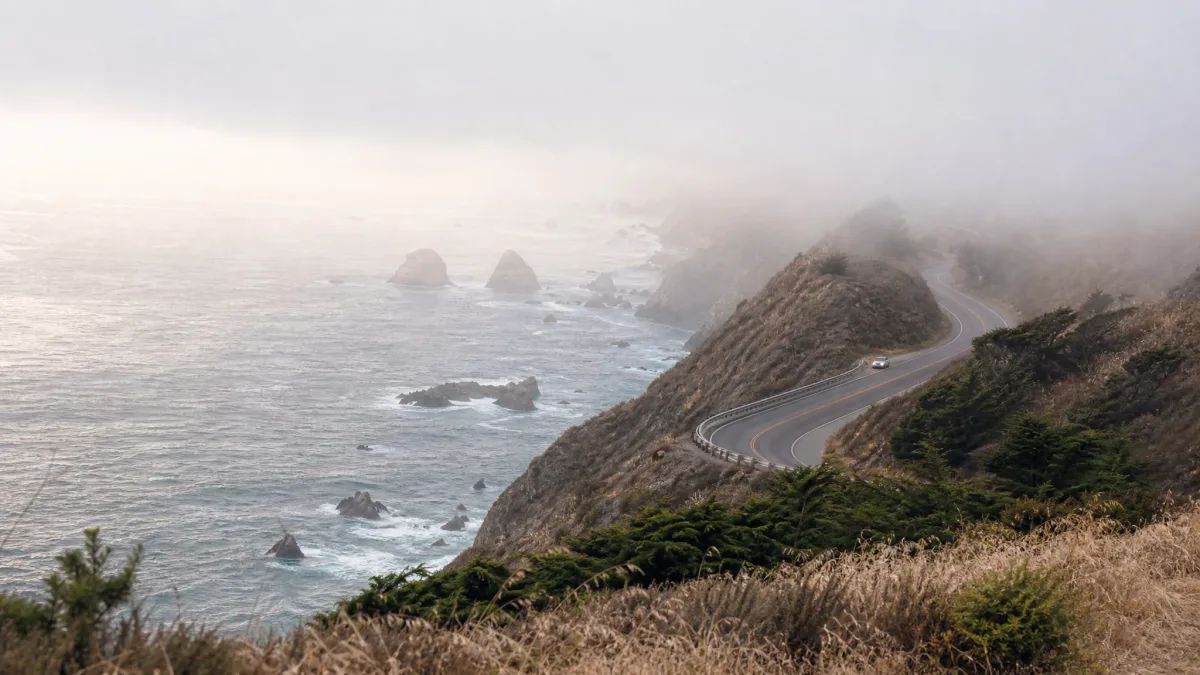
Fog sits on the Pacific at seven in the morning and a two-lane road rides above it, and every car up there has stopped for the same reason.
The saved list of American drives keeps growing. The vacation days do not. So the real question was never which drive is best – it is which one fits the days and the money you actually have.
Every route converts to days the same way: 150 to 300 miles on a full day, one day off the road every three. That is why 469 miles of parkway is a five-day trip and 124 miles of byway is two.
the long weekend, the two-week epic, the winter escape, the fall run. Then open the reservation page for the fixed-date parks, and book the room.
Quick Tips Before You Start
Book the fixed-date parks first
Glacier, Denali shuttles and in-park lodges book two to six months out – lock those before you build anything else around them.
Price the rental before the hotel
A week runs $350 to $600 before fees, and dropping the car in another city adds $100 to $300.
Carry a paper map
Cell coverage drops out on long stretches of nearly every route here, and on Route 66 the map is the navigation, not the backup.
Pack a 5-gallon water jug
Plus a tire plug kit. Both earn their trunk space on the desert and Alaska stretches.
Fill up at half a tank
The Natchez Trace and the Hana Highway run long distances with almost no gas, and Utah's byway thins out fast past Escalante.
Check the closure page the morning of
Big Sur, Trail Ridge and the Beartooth all close on weather, not on a published calendar.
1. Drive the Pacific Coast Highway Through Big Sur
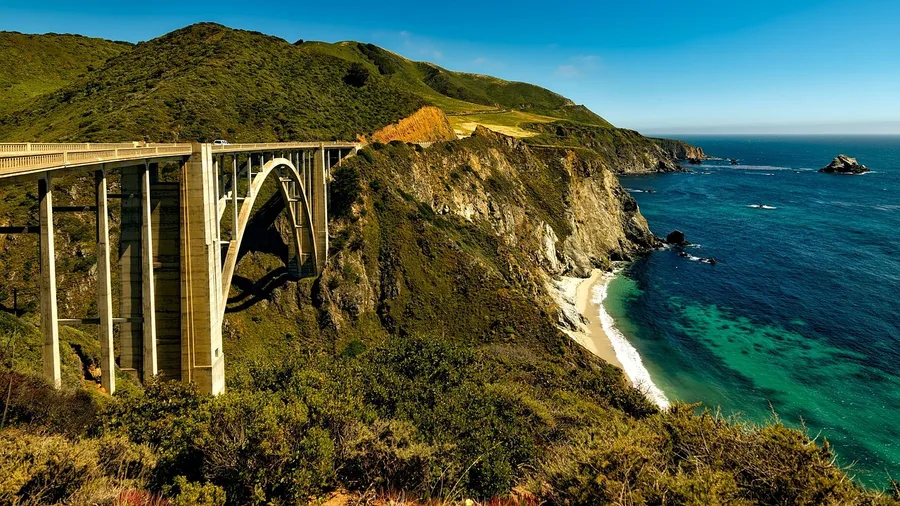
Drive it, and the reward is different from the interior parks: here the payoff arrives unbooked and unoccupied. No permit gates the Pacific Coast Highway, no timed-entry window, no fee booth at the top of a pass. Monterey to San Luis Obispo runs about 150 miles of two-lane cliff road, the water pinned to one side the whole way, and the stop that stays with you is a gravel pullout, not a town.
Give it three days and one night in Big Sur or Cambria at $200 to $250. Push on to Los Angeles and the run stretches to roughly 500 miles. The window is May through October, because winter storms take out the Big Sur stretch and the Caltrans page is the morning-of check, not the month-before. In July and August the traffic arrives in herds and cancels the reason you came.
For wildlife the honest odds: harbor seals and sea otters off the pullouts below Bixby Bridge, and if the wind is right, a spout from a gray whale offshore in spring or fall. You need luck, binoculars and patience, not a ticket – and that is the point of this drive. At 150 miles, fuel is the small line. A night at $200 to $250 and $40 to $60 of food a day are what three days here actually cost.
💡 Tip: The Big Sur stretch closes in winter storms. Check the Caltrans page the morning you leave, not the month before.
| Route | Miles | Days needed | Best months | Typical nightly lodging |
|---|---|---|---|---|
| Pacific Coast Highway, Big Sur | 150 | 3 | May-Oct | $200-250 |
| Route 66, Missouri-Oklahoma | 320 | 3 | Apr-Oct | $150-200 |
| Blue Ridge Parkway | 469 | 4-5 | Late Sep-Oct | $150-250 |
| Scenic Byway 12, Utah | 124 | 2-3 | Mar-May, Oct-Nov | $180-250 |
| Going-to-the-Sun Road | 50 | 2 | Late Jun-mid Oct | $200-250 |
| Trail Ridge Road | 48 | Half day | Jun-mid Oct | $150-250 |
| Overseas Highway to Key West | 113 | 2-3 | Nov-Apr | $250-450 |
| Natchez Trace Parkway | 444 | 3-4 | Apr-May, Oct | Free-$150 |
| Beartooth Highway | 68 | 1 | Memorial Day-Oct | $150-250 |
| Cascade Loop | 440 | 4-5 | Jul-Sep | $150-250 |
| Hana Highway | 52 | 1 | Any, early start | $150-250 |
| Parks Highway to Denali | 323 | 3 | Jun-Aug | $180-300 |
| Twisted Sisters, Texas | 100 | Half day | Mar-May, Oct-Nov | None needed |
| Kancamagus Highway | 34.5 | 1 | Late Sep-early Oct | $150-250 |
2. Follow Route 66 Through Missouri and Oklahoma
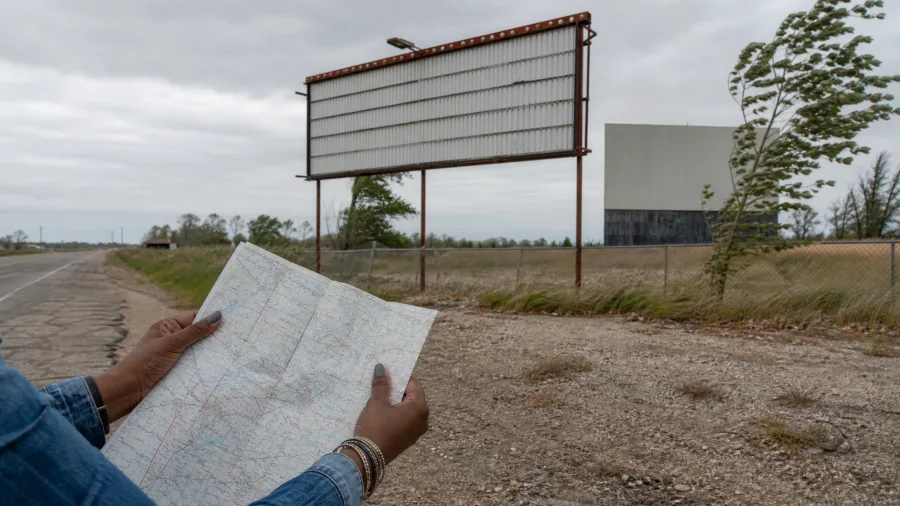
The tarmac hisses under the tires on a hot Missouri afternoon and the smell off the fields comes through the vents, and then a hand-painted sign for a drive-in appears out of the trees. Somewhere under your car is the original concrete. Route 66 is the opposite of a scenic road that hides its history – here the history is the point, and it survives in pieces. From Springfield to Tulsa is about 320 miles over three days, the densest run of original pavement left, and it is the honest unit of the trip.
The stops have names. The Route 66 Drive-In at Carthage, Eisler Brothers store in Galena, the Blue Whale at Catoosa. The full Chicago-to-Santa Monica road runs about 2,400 miles and two to three weeks, and many alignments are now frontage roads, so a paper map is the navigation, not the backup. Motels run $150 to $200 a night, the driving is cheap, and the kitsch – a drive-in ticket, whatever the store sells – is the line that grows. Three days fits a long weekend. The whole road does not fit a week.
💡 Tip: Three days is the honest unit here. The Missouri-to-Oklahoma run fits a long weekend; the whole road does not fit a week.
3. Take the Blue Ridge Parkway in Fall
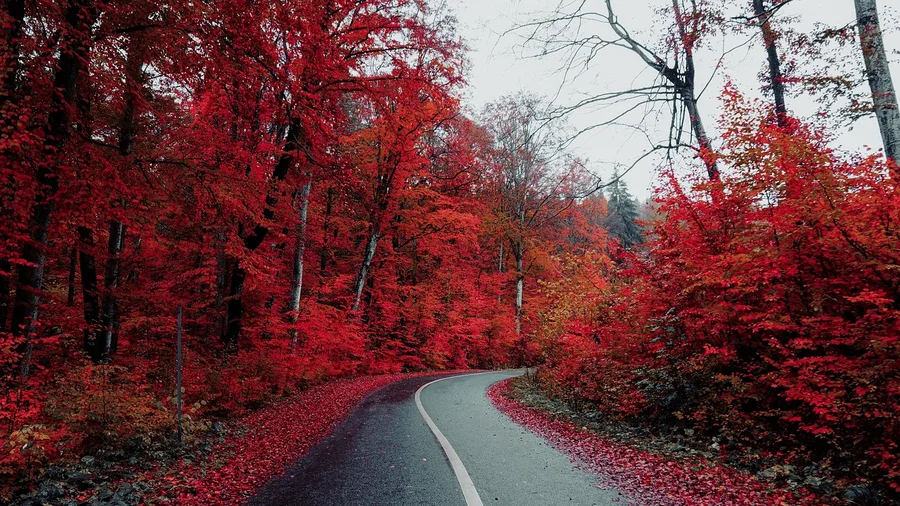
Worth it – if you accept the limit. The road runs 469 miles from Shenandoah, Virginia, to Cherokee, North Carolina, bans trucks and billboards, and holds you to 45 mph. That is four to five days at the pace the road sets.
The color is the reason, and it moves south ahead of you. Late September lights the Virginia end; mid-to-late October catches the country around Asheville. Drive north to south and you follow the season instead of arriving after it. It is also crowded in that window – leaf-peepers and motorcyclists both – but a parkway has no shortcut and no park gates to queue at, so the crowd spreads thin across 469 miles.
Pisgah Inn and the park campgrounds book two to six months out. Fog and closures hit the high sections, so keep the day's plan loose – a morning that starts socked in can clear by the first overlook.
July belongs to people who need to make time, and 45 mph makes that impossible. Nights land in the $150 to $250 band off-parkway, less in a park campground. Five days is the cost of the limit – and the limit is why the drive works.
4. Ride Utah's Scenic Byway 12
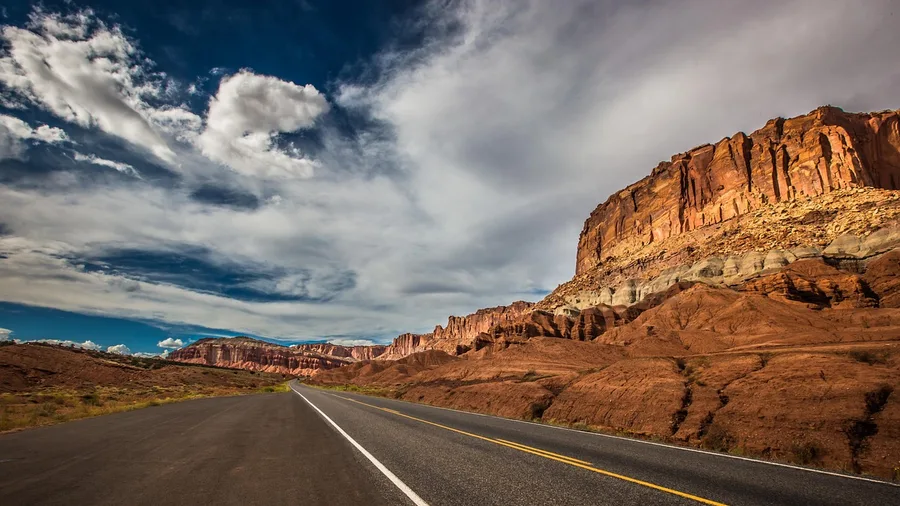
You cannot drive this road fast, and you should not want to. Byway 12 asks the same question a 469-mile parkway asks and answers it in 124 miles: from just outside Bryce Canyon to Torrey, with Capitol Reef waiting at the far end, red rock and slot canyons stacked on one ribbon that crests at 9,000 feet and almost never straightens. No reservation gate. No timed entry. Just a road.
Two days is the floor. A third buys you Kodachrome Basin or the walk to Lower Calf Creek Falls, and either is worth the extra night. For the photograph, stand at the Head of the Rocks overlook in the late afternoon, when the sun drops low enough to light the escarpment in front of you and the switchbacks below go blue in shadow. Spring and fall are the seasons: March through May, October into November. July and August afternoons hit 95 degrees, and the services between towns are thin even then.
Fill the tank in Boulder or Escalante, because the gaps between pumps are longer than the gaps between views. Budget $180 to $250 a night in Torrey, and book it early in the fall-color weeks when the lodge rooms in that range go first. Scenery per mile is the measurement here, and by that measure nothing on this list comes close.
How Tight Is Each Booking Window?
Where the calendar, not the budget, decides whether you go
- Going-to-the-Sun Road: Open roughly ten weeks and needs a peak-season vehicle reservation
- Hana Highway: Open year-round, but a night in Hana is scarce and books early
- Parks Highway to Denali: Shuttles and lodging book two to six months ahead for a short summer
- Pacific Coast Highway: No permit and no timed entry, but check the Caltrans closure page
- Scenic Byway 12: No gate, no reservation – only fuel and lodging in Torrey to plan
Position on the scale reflects how much has to be reserved before dates are set.
5. Cross Going-to-the-Sun Road at Dawn
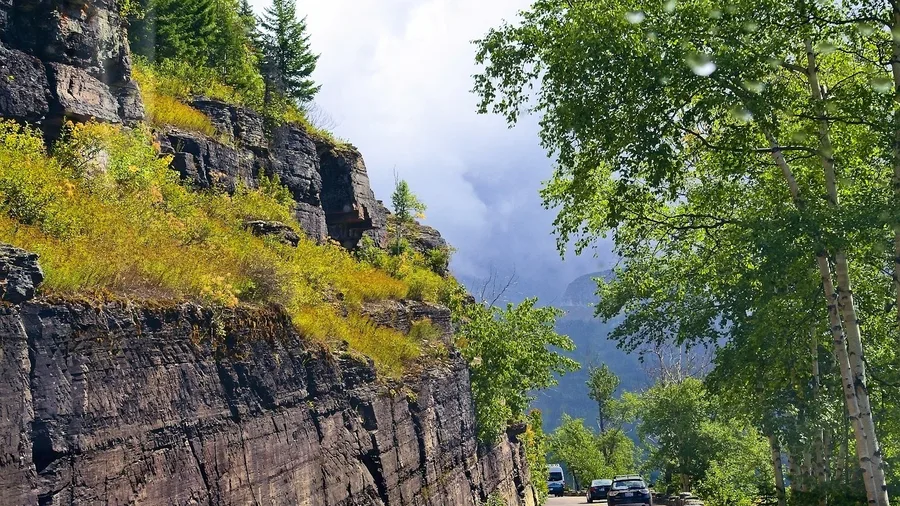
Go at dawn, and know before you commit that this is the tightest calendar on the whole list: fifty miles from West Glacier to St. Mary over Logan Pass, open roughly late June to mid-October, and a peak-season vehicle reservation required. Check the park's official site before you pick your dates, not after.
The road is carved into a mountainside ledge above the valley, so the driver needs a head for drop-offs and the passenger should keep the camera down until the pullouts. Give it two days – Logan Pass at first light, then the walk to Avalanche Lake – and remember the 21-foot vehicle limit. Half a mile on foot past the car thins the crowd to almost nobody, which is the reward for the reservation.
💡 Tip: Anyone willing to walk half a mile from the car is rewarded here. The crowds stay within sight of the pavement.
6. Climb Trail Ridge Road Above the Treeline
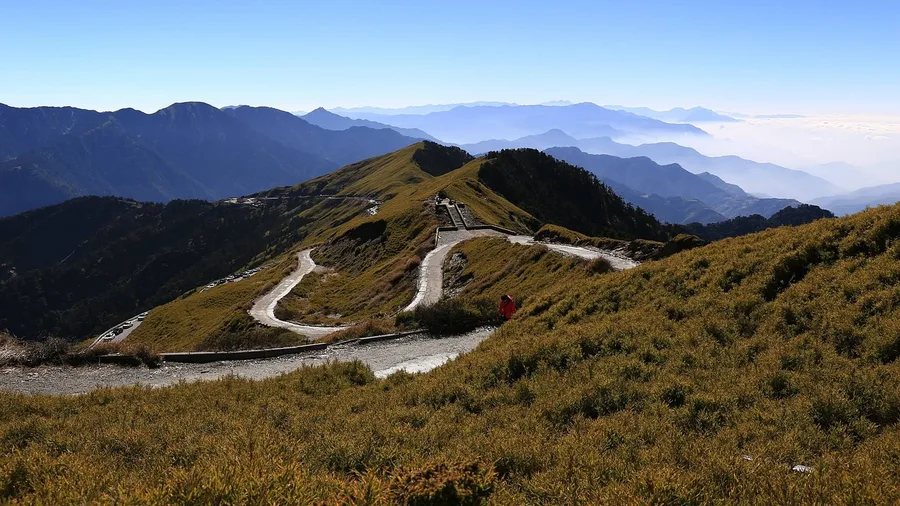
Forty-eight miles separate Estes Park from Grand Lake, and somewhere in the middle of that ribbon the trees simply stop. No trailhead, no permit window, no half-mile walk from a crowded lot – you drive out of the pines and into rock and grass and a horizon that opens like a door. The road climbs to 12,183 feet at its crest, which makes it the highest continuous paved route in the country, and the whole point of it is that the altitude comes to you.
Give it a half day if you are moving, a full one if you plan to stop, and you will stop. Every overlook pulls you out of the car into air thin enough that a flight of stairs leaves you puffing; drink water before you feel thirsty and take the pullouts at a shuffle, not a march. The alpine stretch typically opens around Memorial Day and shuts by mid-October, and it closes at night and in weather even in season – so the plan is a morning plan. Be at the entrance before 8 a.m., because by mid-morning in July the line at the gate costs you an hour you could have spent at 12,000 feet.
7. Swim Off the Overseas Highway to Key West
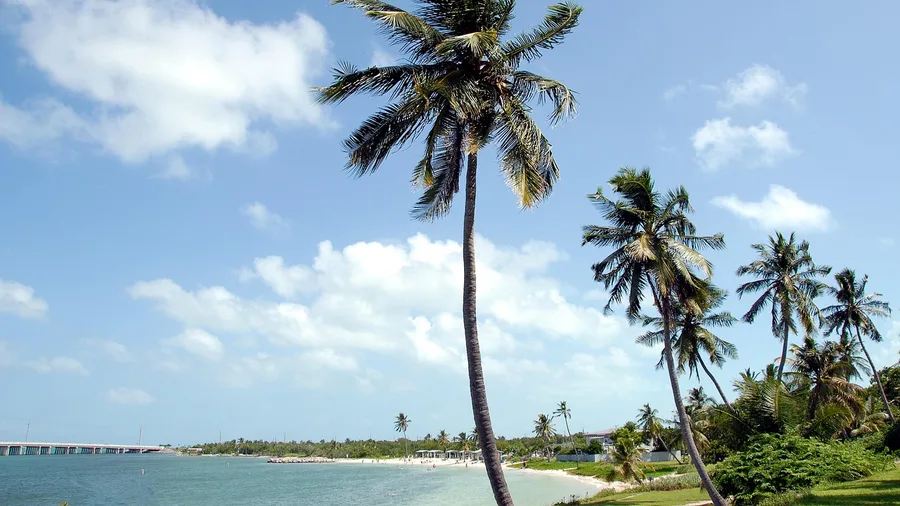
The water hits your ankles at Bahia Honda and it is already warm, bath-warm in February, and the sand under it is white enough that you squint even through sunglasses. This is what the drive buys you. When the high country closes at the first snow, the season-defining drive moves down to sea level, and here the season is the one the rest of the country writes off.
The run is 113 miles from Florida City to Key West, about four hours if you never pull over, the Atlantic running along one shoulder and the Gulf along the other. Nobody should do it in four hours. Take two to three days, sleep one night in Islamorada and one in Key West, and swim at Bahia Honda State Park, walk the old span of the Seven Mile Bridge, wade out onto the sandbars off the lower keys. King tides flood stretches of the road in the wet months, and the Atlantic hurricane season overlaps them from June through November, so November to April is the clean window.
Key West is where the budget stops being polite: rooms run $250 to $450 a night in season, which is why you book two to six months out and take what is left. A week's rental car sits in the $350 to $600 range before fees, and that is the honest figure for parking the thing in a town you will cross on foot. Book the room first and let the drive fit around it.
8. Wander the Natchez Trace Parkway
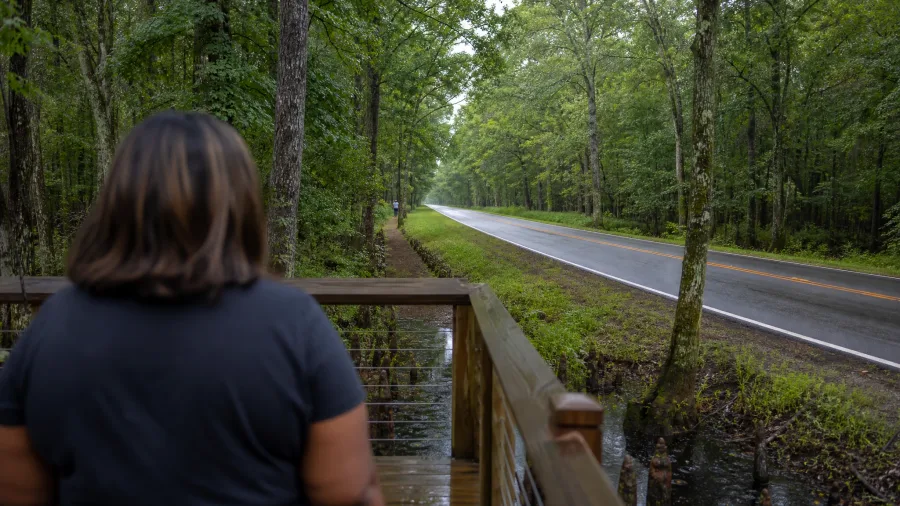
The Natchez Trace Parkway is 444 miles of two-lane road from Natchez, Mississippi, to Nashville, Tennessee, and it asks nothing of you but time. No billboards, no trucks, no commercial traffic, a 50 mph limit and a park-service campground at the end of most days that costs nothing to pitch a tent in.
Allow three to four days. Stop at Emerald Mound, walk the Cypress Swamp boardwalk, take Tupelo on the way through and Leiper's Fork near the northern end. Fill the tank before you join – gas stations are few and far between – and carry food, because the road itself has almost none. April and May or October are the months. This is a slow traveler's drive: if you have a deadline, take the interstate and say so out loud. Everyone else gets the rare long road where the miles come off the odometer and the nights come off the budget at zero, which is the reverse of the trade the Overseas Highway makes.
9. Splurge on the Beartooth Highway
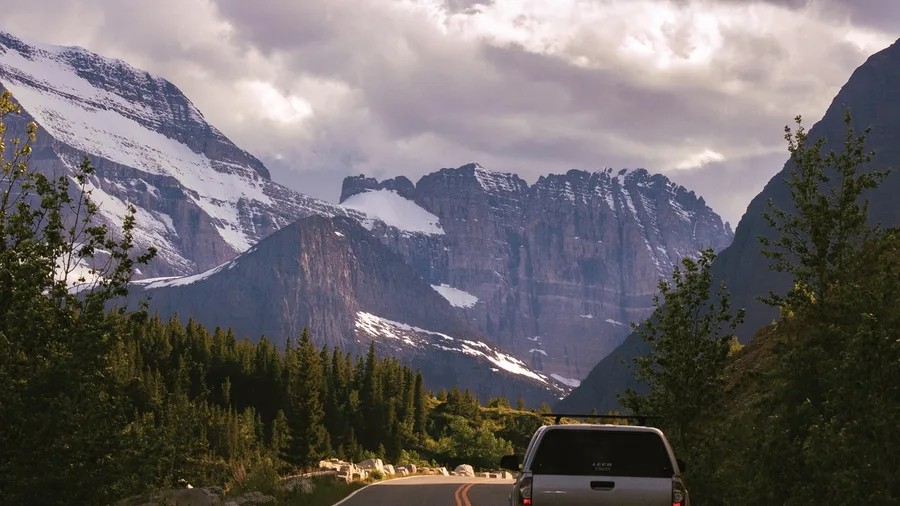
Up on Beartooth Pass the air is thin and smells of wet rock and old snow, and even in July the wind off the high basin has an edge that makes you zip your jacket at 10,947 feet. The quiet parkway you just left asked nothing of you. These 68 miles from Red Lodge, Montana, to Cooke City ask for a steady hand and give it back in switchbacks above Rock Creek Canyon and a horizon that keeps opening.
Three hours without stopping, a full day with them, and the last stop doubles as the point: Clay Butte lookout for the view, then Yellowstone's northeast gate at the end of the road, where you enter the park with none of the crowds that queue at the west entrance. Skip it in a big RV or with a trailer hitched behind. The pass opens around Memorial Day and shuts with the first heavy October snow, so check Montana DOT before you commit, not last year's calendar. The splurge is the night at either end, $150 to $250 in Red Lodge or Cooke City, which turns the drive into a day instead of a haul.
💡 Tip: Yellowstone's northeast gate sits at the end. Sleeping in Red Lodge keeps this a day rather than a haul.
10. Linger on the Cascade Loop
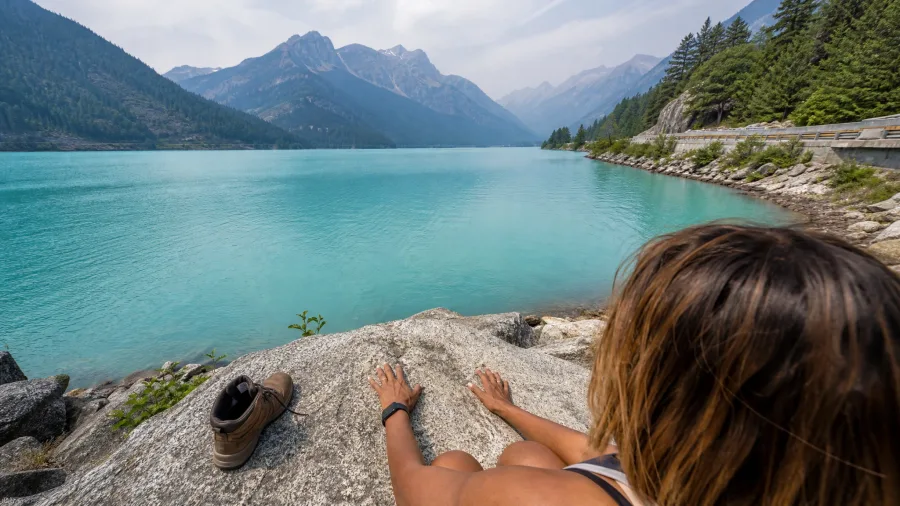
A straight line demands less of you than a circle. The passes before this one run up and over and finish with a gate and a park at the end; the Cascade Loop asks for the same money and the same week and hands back a rainforest, two mountain passes, a saltwater strait and an island, all on one tank-at-a-time circuit out of Seattle and back into it. It is 440 miles and four to five days, and it is the rare drive where you can stop moving for an hour and the trip gets better, not behind.
The shape of it: east over Stevens Pass, north up the North Cascades Highway, a ferry ride spliced into the middle, and south again to the city. Deception Pass is the bridge you slow down for, water tearing through a narrow channel under you. Diablo Lake is the color nobody believes until they see it – a milky turquoise from glacial flour, best from the pullout on the highway. Washington Pass is the high point. Leavenworth is the fake-Bavarian town you either love in ten minutes and leave, or stay in for the beer.
Here is where the loop earns the slow day the other drives on this list do not give you. Take the Diablo Lake overlook, then drive down and sit by the water and do nothing for an hour – the lake does not change, and that is the point. The North Cascades Highway shuts roughly November through April under snow, so July to September is the window, and those are also the months the wildflowers and the long light line up. Book nothing on the pass itself; book the night either side.
The ferry is the piece that decides the plan. It sits in the middle of the route and it does not run to your schedule, so if you are short on days, cut the water crossing and drive the loop on land – you lose an island, not the mountains. This is a hiker's drive with a week to spare; pack the boots, leave slack in the day for a trail off the highway.
The math: $150 to $250 a night in a motel or cabin, $40 to $60 a day in food, $50 to $90 a day in fuel at the 300 to 400 miles the longer legs run. Four days at the low end is a real number, and the ferry fare is the small line that changes it. The mountains do not care how fast you go. The one who lingers by the lake at Diablo gets the drive the others miss.
⚠️ COMMON MISTAKE
Do not book lodging before you check the park page
Several parks now use timed-entry or vehicle reservations. Check each park's official site before you set dates – a nonrefundable cabin two hours from a gate you cannot enter is the most expensive mistake on this list.
11. Time the Hana Highway for Dawn
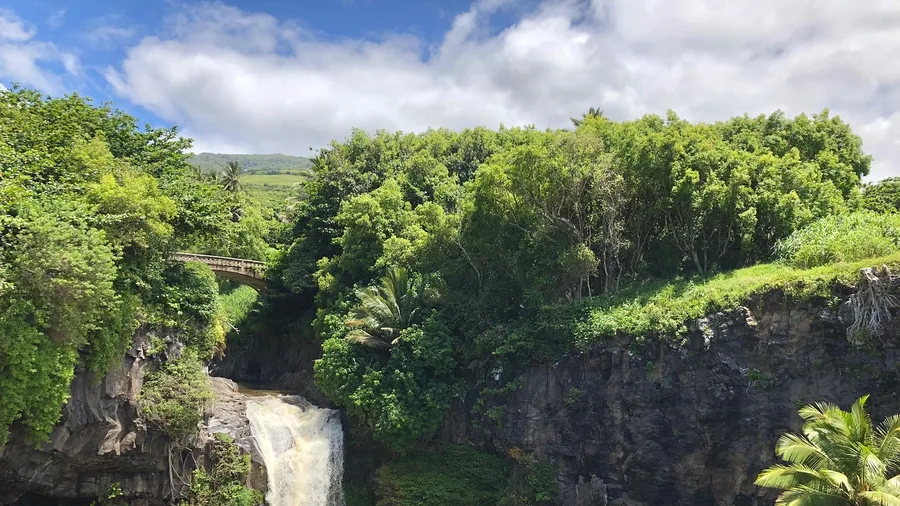
The curves will get you before the distance does. Fifty-two miles separate Kahului from Hana, and the road spends them on 620 bends and 59 one-lane bridges – three hours of wheel-turning if you never pull over, and you will pull over. Anyone who goes green in the passenger seat should take the south route back around the island or stay at the resort; there is no version of this drive where the motion stops.
Leave at 6:30 a.m., drive clean through to Hana while the road is yours, and spend the return moving at half speed through the waterfalls and pullouts you skipped. The convoy forms behind every tour van that leaves after eight; by nine the same 52 miles crawl. The rainforest the North Cascades spreads over 440 miles and five days is here compressed into one wet green morning, and the rental agreement needs reading before the wheels turn – the back side past Hana toward the pools at Oheo turns to broken pavement and rough gravel, and some companies forbid it outright. It is their call, not yours.
Fuel is the smallest line on this entry: 52 miles is barely a quarter tank. The cost is the car and the bed – a room in Hana sits in the $150 to $250 band and there are only a handful of them, so book months out or drive back to the west side the same afternoon. Get up early, get through before the crowd, and the road everyone complains about turns into the best three hours of the trip.
12. Catch Denali on the Parks Highway
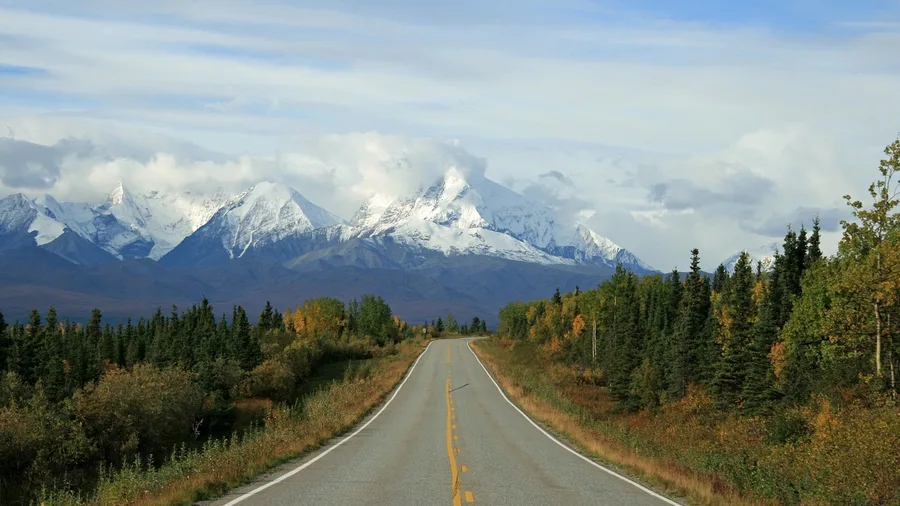
A long empty highway with one mountain at the end of it. Anchorage to Fairbanks is 323 miles of spruce, river and sky, and the whole show hangs on whether Denali decides to come out of the cloud – roughly five to six hours behind the wheel without stopping, three days once you fold in the mountain and Talkeetna.
The mountain tends to show around mile 130, and often it does not. Residents who make this run build a spare day into it rather than gamble the whole trip on a clear Tuesday, and the summer window is short – June through August, with fuel at Cantwell and Healy, long gaps between, and the bars on your phone gone for most of the drive. Park shuttles and lodging go two to six months ahead; book those before you pick the dates, not after.
The line that catches people is the car. A week's rental runs $350 to $600 before fees, and turning it in at Fairbanks instead of Anchorage adds $100 to $300 for the one-way drop-off – the cost that separates a plan from a wish on this drive. It stays light until nearly midnight in July, so the miles fit an evening you did not expect to have.
13. Ride the Twisted Sisters in Texas
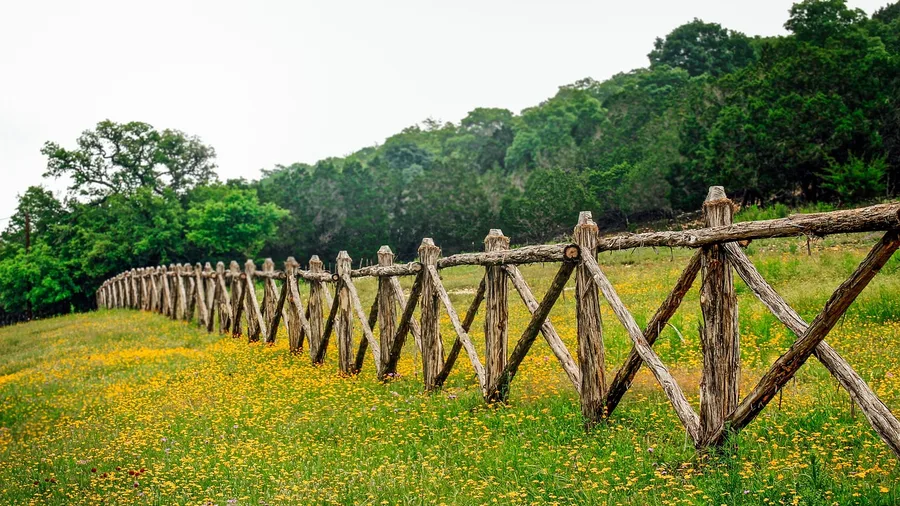
Texas, of all places – and the drive that answers it is the ranch road loop out of Leakey and Medina, where 335, 336 and 337 twist through the Hill Country for about 100 miles. Alaska asks for a week, a rental and a spare day for cloud; this asks for one long half day and a full tank. Base yourself in Austin, drive out in the morning, and you are back for dinner. The curves are tighter than anything around them and the elevation change is a few hundred feet at a time, not a pass.
The reason to come is the Frio Canyon, and the reason to stop is a burger and a cold drink at a gathering spot in the canyon when the afternoon flattens out – expect roughly $15 to $20 a head, cash handy because small kitchens move at their own speed. March to May and October to November are the months; summer afternoons hit 100 degrees with almost no shade, so the roadside pull-offs become oven doors. Work in Lost Maples State Natural Area and Garner State Park if you want a hike between curves, then respect what the asphalt tells you: gravel washes across the bends, livestock wander, and cell service drops. A tire plug kit and a paper map earn their place here. No lodging needed, one tank of fuel from Austin – this is the cheapest day on the list, and the one to take when the calendar is short.
💡 Tip: A tank of fuel from an Austin base and no lodging required make this the cheapest day on the list.
The Tourist Version vs. the Version That Works
The obvious plan
- Drive the Hana Highway at 10 a.m. with everyone else
- Sleep in Jackson or Estes Park and queue at the gate at 9
- Book the cabin, then read the park reservation page
- Do the whole 2,400 miles of Route 66 in one week
What actually works
- Leave the Hana Highway at 6:30 a.m. and stop on the way back
- Be at the Trail Ridge entrance before 8 a.m. in summer
- Check timed-entry and vehicle reservations before setting dates
- Drive the 320-mile Missouri-to-Oklahoma stretch and save the rest
14. Book the Kancamagus Highway Early
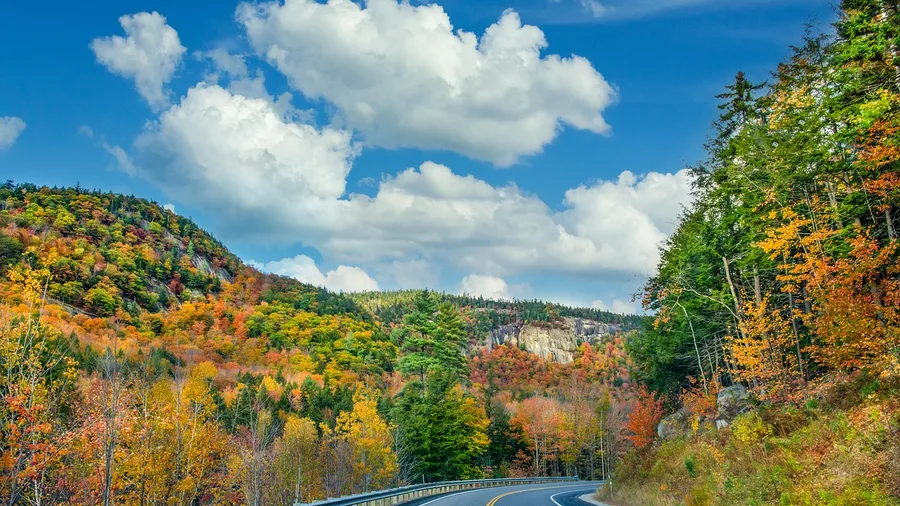
Book it early, because the catch is entirely in the calendar. New Hampshire's Kancamagus Highway is the smallest commitment on this list – 34.5 miles of White Mountain forest between Lincoln and Conway – and it carries the sharpest deadline of any drive here. Two hours end to end without stopping; a full day if you add a hike or two. Peak color usually arrives in the last week of September and holds about a week into October, and the rooms along the corridor sell out for that window months ahead. Two nights at $150 to $250 plus fuel is the whole budget. Columbus Day weekend is the one to avoid – go the weekend before or the one after.
Plan the stops so the car is not the whole trip: Sabbaday Falls, the Sugar Hill overlook and Rocky Gorge, in whatever order the traffic allows. There is no food and no fuel on the road itself, so fill up and eat before you turn onto it. From Boston it is a Friday-night-to-Sunday run, and that is the point – the smallest unit on the list is still a real drive, provided the booking happens before the leaves decide.
💡 Tip: A weekend from Boston covers it. This is the smallest commitment on the list with the sharpest deadline.
What a Week on the Road Costs
Frequently Asked Questions
Do I need a reservation for these drives?
Most of them, no. Going-to-the-Sun Road requires a peak-season vehicle reservation, and several parks now use timed-entry systems. Check each park's official site before you set dates, and book in-park lodges and campgrounds two to six months ahead.
How many days should I allow?
Plan 3 to 14 days depending on the route. Drive 150 to 300 miles on a full day and take one day off the road every three. The 50-mile mountain drives fit in two days; the Blue Ridge Parkway and Cascade Loop want four or five.
What does a road trip like this actually cost?
Budget $150 to $250 a night for a mid-range motel or cabin, $40 to $60 a day per person for food, and $50 to $90 a day in fuel at 300 to 400 miles. A week's rental car runs $350 to $600 before fees, and a one-way drop-off adds $100 to $300.
Which drive should a first-timer pick?
The Pacific Coast Highway between Monterey and San Luis Obispo. It needs no permit, no timed entry, and the scenery does the work – three days, one night in Big Sur or Cambria, and a closure page worth checking the morning you leave.
When is the best time for the fall drives?
Late September at the Virginia end of the Blue Ridge Parkway, mid-to-late October near Asheville, and roughly the last week of September to the first week of October for the Kancamagus. Book those rooms months out – the color window is short and everyone knows the dates.
Is it worth driving Route 66 if I only have a long weekend?
Yes, if you take the 320-mile Springfield-to-Tulsa stretch over three days. Skip the full Chicago-to-Santa Monica run at 2,400 miles – that needs two to three weeks, and much of the original alignment is now frontage road.
The One Route I'd Reroute Next Time
Pick by situation, not by wish list. The three-day weekend is Route 66 from Springfield to Tulsa – 320 miles, $150 to $200 motels. The two-week epic is the full Chicago-to-Santa Monica Route 66, 2,400 miles, the same road at the other scale. The winter escape is the Overseas Highway, Florida City to Key West, November to April. The fall-foliage run is the Blue Ridge Parkway in the last two weeks of October, or the 34.5-mile Kancamagus if only a weekend exists. The first-timer's safest is Monterey to San Luis Obispo on the PCH – three days, no permit, everything serviced.
The saved list is now fourteen lines with days, dollars and months attached, which is the difference between a daydream and a plan.
First action, before routes or dates: check the reservation page for the fixed-date parks – Glacier's peak-season vehicle reservations and every timed-entry park – and book the lodging, park lodges, in-park campgrounds and Key West rooms two to six months out, then build the drive around the confirmed night.
Do that, and the next time fog rolls off the Pacific at 7 a.m., you will be one of the cars pulled over – not because you stumbled on it, but because you planned for it.
Check the reservation page before you book anything
Open Glacier's and Denali's official sites now, confirm the timed-entry rules, then lock two nights of lodging. That is the whole first move – do it this week.