
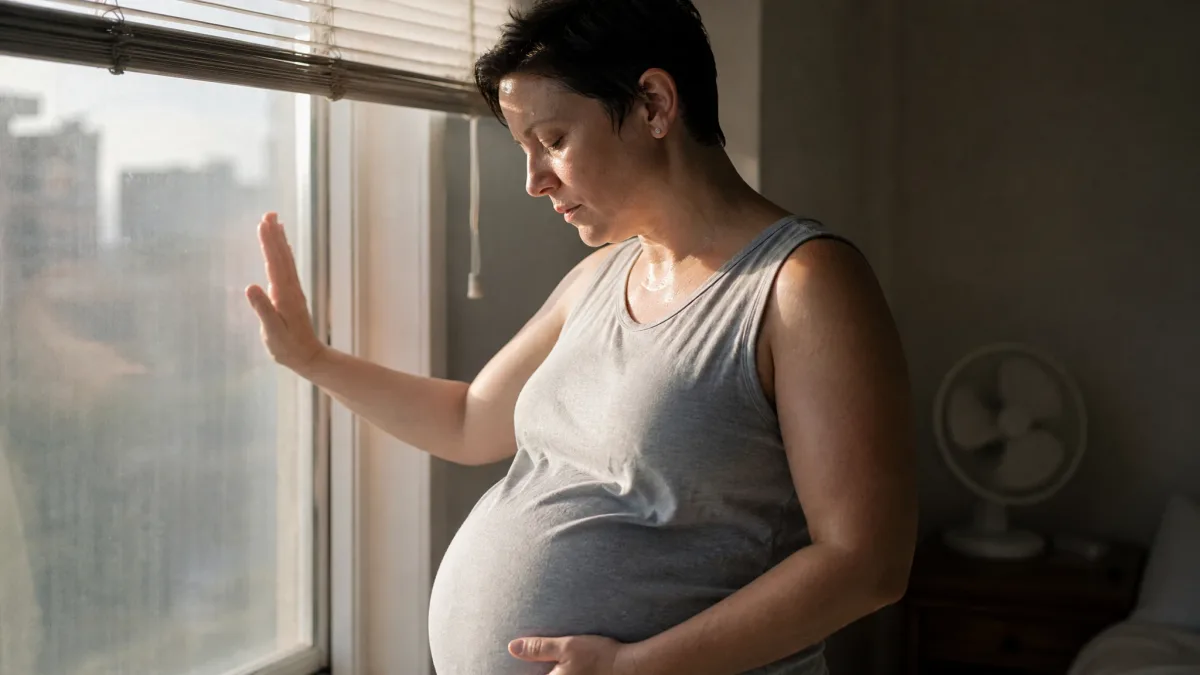
A hot stretch in late pregnancy is linked to a 16% higher chance of a baby arriving before 37 weeks, a sobering size of risk. That figure is not from one small sample. It comes from a review of 70 studies, and it is the sort of number you may have scrolled past on a hot afternoon, wanting a straight answer about whether heat is a genuine danger in pregnancy.
The studies behind the headlines tie heat to early birth, low birth weight, heart defects, stillbirth and a blood-pressure complication called preeclampsia. Almost all of the human evidence is observational: researchers watched what happened to pregnancies rather than testing heat on people.
So the risk is real but imperfectly measured. The links are serious and they repeat, the sizes vary by outcome, and no study hands you a temperature to treat as safe. Read on to see which outcomes carry the biggest measured links, what the evidence cannot establish, and why the one number most wanted, a dangerous temperature, is missing.
Heat is more than a discomfort in pregnancy

Heat does not just make late pregnancy uncomfortable. Across dozens of studies, hot days show up again and again alongside babies born too small, too soon or with serious problems.
The outcomes on that list are low birth weight, early birth, preeclampsia, heart defects and stillbirth. Each one can shape how a child fares through infancy and beyond.
Dr. Susanna Esposito, who practices pediatrics at Italy's University of Parma, puts the physical reason plainly: "Pregnant people are physiologically more vulnerable to heat." A pregnant body carries extra weight and works harder to keep its own temperature steady.
The number of people exposed to this is growing. The United Nations expects the world will likely pass 1.5 C (2.7 F) of warming above pre-industrial levels within five years, and may go beyond 2 C (3.6 F) in the same stretch, so more pregnant people and newborns will meet more hot days.
One caution runs through every human study behind these outcomes. They are observational, which means they watched what happened rather than testing heat against a comparison group, so they show links but cannot prove heat caused any one baby's problem.
That leaves a small discomfort sitting inside a large public question. The measured links are serious, the exposed population keeps growing, but each link is a signal whose cause is still not pinned down.
| Outcome | Size of the link | Where the study looked |
|---|---|---|
| Preterm birth, heat wave in final weeks | 16% higher chance | Review of 70 studies |
| Preterm birth, per 1.8 F (1 C) across pregnancy | 5% higher risk | Review of 70 studies |
| Low birth weight | More than twice as likely | France, 2003 heat wave |
| Critical heart defects | 6% higher risk | Canada |
| Stillbirth | 3% higher risk | Six U.S. states |
| Severe preeclampsia | Slightly increased risk | France, 2011 study |
Babies arrive earlier when the heat hits

Early birth is where the numbers are steadiest. A review of 70 studies found that when a heat wave of several days landed in the last weeks of pregnancy, the chance of a baby arriving before 37 weeks was 16% higher.
The same review caught a slower effect across the whole pregnancy. For every extra 1.8 F (1 C) of average temperature, the risk of preterm birth went up 5%.
A U.S. analysis added a measure of time: on hot days, deliveries came roughly six days sooner than expected on average, and some babies arrived up to two weeks early.
Those last days and weeks matter more than they sound. Clara Heil, a health researcher at Lund University in Sweden, notes that a baby born too soon faces "a heightened risk of all sorts of adversities throughout infancy, but then also extending into childhood and even longer term."
Read the 16% and the 5% carefully. They are measured associations, not counts of births that heat caused. What they show is early birth tracking both a short, sharp heat wave and the slow warmth of a whole pregnancy.
What else the research tracked
Figures the early-birth numbers leave out, and how firmly each is known
Each of these is a measured association in a study group, not a cause and not a personal risk estimate.
The links reach growth, the heart and blood pressure

Heat turns up in studies of birth weight, the heart, stillbirth and blood pressure, too.
France's 2003 heat wave gave one of the biggest signals. Mothers pregnant during it were more than twice as likely to deliver a low-birth-weight baby, and that link was strongest in the first trimester.
In Canada, researchers looked at critical heart defects in newborns. The odds were 6% higher after heat exposure, and the risk was greatest for babies whose mothers faced 86 F (30 C) or hotter on at least 15 days of that first trimester.
Stillbirth carries a smaller but quieter signal. Across six U.S. states, four unusually hot days in a row during the final week of pregnancy, above the 97.5th percentile of local temperatures, were tied to a 3% higher risk.
A 2011 French study pointed the other way in timing, tying hotter first-trimester days to a slightly raised risk of severe preeclampsia, a blood-pressure complication that can be fatal. Hot weather has also been linked to gestational diabetes and hypertension.
Notice what that spread means. The outcomes stretch across pregnancy and the sizes run from 3% to more than double, and each one is an observed link whose cause remains unsettled.
Why heat might affect a pregnancy at all

A plausible reason heat could reach a fetus is cortisol, the hormone the body releases under stress. In lab animals, heat stress may push cortisol above the levels considered healthy in pregnancy.
That idea comes from lab animals, not from pregnant people, and the feature says it is not fully understood in humans. It is a hypothesis, not a demonstrated cause.
Other explanations sit even further from settled. Why heat is linked to low birth weight is still being studied, and why first-trimester heat might raise the risk of severe preeclampsia needs more research.
A biological story, then, but an incomplete one. It offers a way to picture how heat might matter without proving that heat did the work.
For a reader, that changes little in practice. A story about cortisol may explain how warmth could matter, but it does not turn an observed link into established personal harm.
💡 PRO TIP
How to read a heat-and-pregnancy headline
Find the number, then find what it compares. A 6% rise in a rare outcome means very few babies, while 16% on preterm birth touches a common event. Then check for the word linked, associated or tied. Those words are the researchers telling you they did not prove cause.
What these studies can't tell you

A believable biological story does not repair the evidence underneath it. Every human study here watched people rather than tested them, so each one can show that heat and poor outcomes travel together – not that the heat did the damage.
Picture a county sweltering through a hot week. Some pregnant residents had air conditioning and some did not, and the studies did not record which was which, or how much time anyone spent indoors. So how hot any one body actually got stays a guess.
The body of work pulled together for the review is patchy, too. The studies vary considerably in their coverage and design, so a single tidy figure cannot stand for all of them.
There is a paper-trail problem as well. No formal study record could be found for the review, so nobody outside the work can check how many people the individual papers followed, who paid for them, or where they appeared.
None of this makes the findings worthless. The patterns repeat across many studies, and repetition is its own kind of strength.
But a percentage from any one paper is a group average, not a forecast for one pregnancy. Read them as signals of a real trend, not as your own odds.
This question is older than this summer

Researchers have been circling this question for a long time, and the warming is what turned scattered local findings into a worldwide worry. None of the doubts are new; they have simply grown with the map.
Start with France in the summer of 2003, when a heat wave struck. Years later, researchers went back through birth records from mothers pregnant during it and found more low-birth-weight babies among them.
A 2011 French study later tied hotter first-trimester temperatures to a slightly higher risk of severe preeclampsia. An Arizona study found hotter third-trimester temperatures were associated with lower birth weight.
Clinical records keep arriving at the same door. Heat has also been linked to more emergency hospital admissions during pregnancy.
The United Nations expects the world will likely pass 1.5 C (2.7 F) of warming above pre-industrial levels within five years, and may pass 2 C (3.6 F) in that time.
Two decades of local signals, set against that forecast, turn a personal question into a global one. The same uncertainty about cause follows the science to the larger scale, and it has not shrunk.
How hot is too hot? Nobody can say yet

No one can name that temperature. Researchers have not pinned down how hot it has to get before heat becomes dangerous in pregnancy.
They also don't know whether a threshold exists at all, a point where the pregnant body can no longer shed heat. Until someone finds one, no forecast can tell a pregnant person their own risk on a given day.
The size of the links reported across two decades of studies is not the only thing left open. Whether those links reflect heat causing the harm, or other factors that travel with hot weather, is still unresolved.
The studies also did not account for where people live or how they cool off, so how much heat anyone actually experienced is unclear. Whether counting those differences would shrink or grow the estimated risks is unanswered.
Clara Heil, a health researcher at Lund University in Sweden, has posed questions that still have no answer.
It would be helpful to know how much heat puts women in danger, she said. And: Is there a point at which the body struggles to shed heat?
Those are real questions, not settled science. A pregnant reader can watch the forecast, but the science cannot yet say which number in it should change what they do.
Frequently Asked Questions
Is heat actually dangerous during pregnancy?
Heat has been linked to serious outcomes including preterm birth, low birth weight, critical heart defects, stillbirth and severe preeclampsia. The studies are observational, so they show links rather than proof of cause. The risk looks real, but the size of any individual's risk is not known.
At what temperature should a pregnant person start worrying?
Nobody can say. Researchers have not established what temperature becomes dangerous for pregnant people, or whether there is a point at which the pregnant body struggles to shed heat. The risk appears to rise with heat without a known threshold.
How much higher is the risk of early birth in a heat wave?
A review of 70 studies found a 16% higher chance of preterm birth, meaning before 37 weeks, when a heat wave of several days hit in the final weeks of pregnancy. For each additional 1.8 F (1 C) of average temperature across the whole pregnancy, preterm birth risk rose 5%.
Did these studies prove that heat causes early birth?
No. Every human study described is observational, so it shows an association between heat and outcomes without establishing cause. The studies also did not account for participants' home environments or how they cooled off, so actual heat exposure is unclear.
Why might heat affect a pregnancy?
The leading proposed mechanism involves cortisol, a hormone released under stress. The idea is that heat stress pushes cortisol above healthy pregnancy levels, but that evidence comes from studies in lab animals and is not fully understood in humans. Why heat is linked to low birth weight is still being studied.
Will warming temperatures make these risks worse?
The United Nations predicts the world will likely cross 1.5 C (2.7 F) of warming above pre-industrial levels within five years, and may pass 2 C (3.6 F) in that time. More hot days means more pregnant people exposed, though how much any individual's risk rises is not established.
The Missing Temperature, and Why It Matters
The verdict is plain: heat is a genuine pregnancy signal, early birth is among the clearest expressions of it, and the evidence stays observational with no threshold established.
That forecast on your phone still cannot tell you your own risk. It can tell you it is hot, and nothing more precise than that.
Heil's question lingers: at what point, if any, does the body struggle to shed heat? Whether such a point exists at all is unknown.
Which brings you back to where you started, to that 16% from a hot stretch in the final weeks. It is a real number from 70 studies, and it is not a personal one.
Sources
- Rising temperatures could boost pregnancy risks worldwide — here's how – livescience.com (news report) · 2026-10-19