
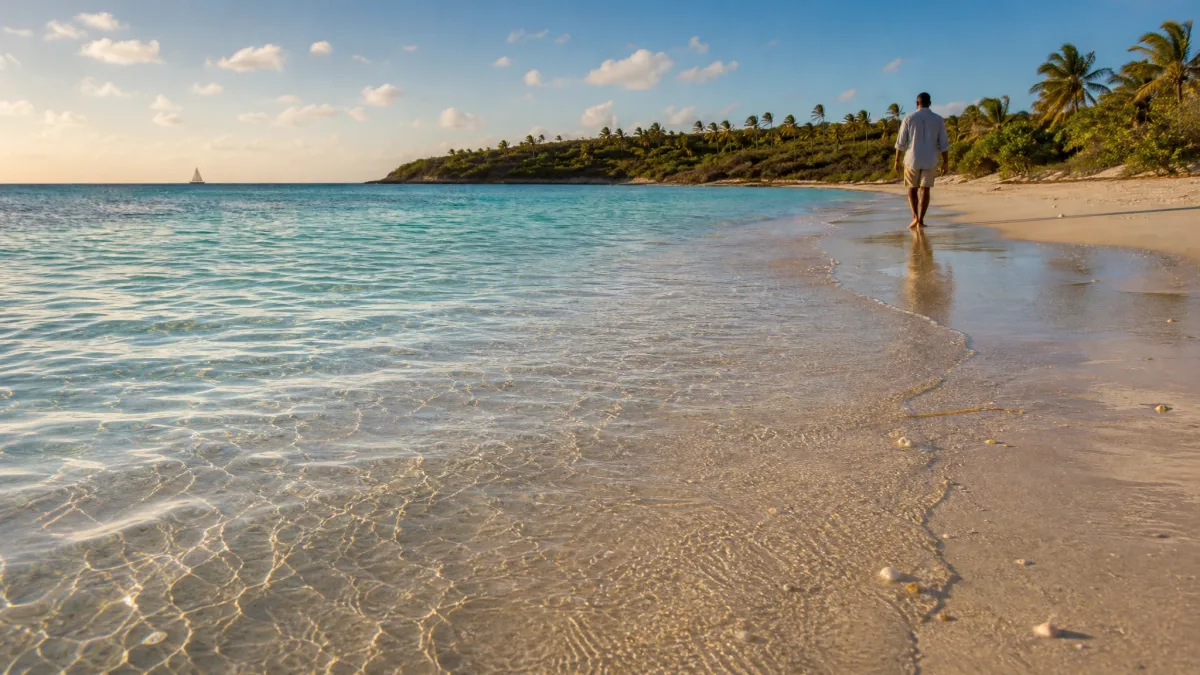
Most people shopping an island residency start by comparing headline investment numbers, then hand an agent a retainer and hope. That is backwards. The investment is the one figure the government prints clearly. The fees, due diligence checks, apostilles, flights and holding costs are where the surprise lives.
The anchor case used throughout this article: a US couple in their early 40s with two children under 18 and about $350,000 of investable capital set aside for a second residency, comparing four island programs. Their all-in outlay beyond the qualifying investment ranges from $24,000 to $39,500 before a single property closing cost. Read every program through that lens.
The shortlist is Antigua and Barbuda, St Kitts and Nevis, Dominica, Grenada, Saint Lucia, Vanuatu, plus Malta as the Mediterranean alternative. Each has run a program at some point; several have raised thresholds or closed real estate routes in recent years, so every number needs a date and an official page attached.
What you can actually do with the card: live on the island, enroll children in school, renew on a five- or ten-year cycle, hold a property you may sell down the line, and — only after naturalization — travel on a different passport. This post walks you through what each program demands in cash, calendar and paperwork, and what it hands back. Pick the entries that fit your family; you do not have to chase all twelve.
Quick Tips Before You Start
Pull source-of-funds paper early
Bank statements, tax returns, gift letters and property sale deeds should cover 6–10 weeks of assembly before you pay anyone.
Use the government page, not the agent's
The unit that runs the program publishes its own thresholds, fee schedule and presence rules; read them there first.
Budget two trips
Plan for a five-day scouting trip at around $2,500 for two and a four-day biometrics return at about $2,000.
Count family costs separately
Spouse and minor children ride on one application; parents and adult children are a second line at roughly $15,000–$25,000 each.
Model the five-year day total
A 14-day-a-year rule is 70 days over five years; a 30-day rule is 150. Plan against US school terms before committing.
Ask about non-refundable fees
Application and due diligence fees often stay with the government if you are refused; confirm in the program's published terms.
Which islands actually run a residency-by-investment program
The list is short. A handful of Caribbean jurisdictions plus Malta in the Mediterranean have run investor residency routes in recent years, and not all of them offer the same thing under the same name. Some sell residency; some sell citizenship by a different process; several have raised thresholds or shut their real estate route outright.
Start from the government unit that runs the program — the citizenship-by-investment unit or immigration authority — not an agent's comparison site. The official page carries the current threshold, the fee schedule and the presence rules with a date on them.
1. Five Caribbean islands and one Mediterranean alternative

Before you compare a single island, know that the menu itself moves under you. Thresholds get raised. Real estate routes get closed outright. Several jurisdictions have tightened the numbers in recent years, which means any figure you saw on a forum thread, in a YouTube video, or on an agent's comparison site is a rumor until you can date it and link it.
The jurisdictions worth putting on the table are a short five Caribbean islands plus one Mediterranean alternative: Antigua and Barbuda, St Kitts and Nevis, Dominica, Grenada, Saint Lucia, and Vanuatu, with Malta as the European option, though islands that are surprisingly affordable are a cheaper way to test the region. Those are the ones a family with about $350,000 of investable capital actually ends up weighing against each other, and each runs its own qualifying thresholds, its own family terms, its own presence rules.
Vanuatu sits half a world from the others, so the trips cost more and the air routings stretch to two connections; Malta prices in euros and sits inside Europe's orbit. The five Caribbean programs compete more directly, with real estate and donation routes that vary by island. Some sell only one route. Some price the two so differently that the lower headline number hides the higher fee stack.
treat the shortlist as a starting point, not a settled menu. The only source that counts is the government unit that runs that specific program, on its own official page, and every threshold you read needs a date attached so you know it is current. That page is what an agent should be quoting from; if they cannot point you to it, you are paying for a summary, not a service.
The scouting trip is where this splurge starts earning back. Budget about $2,500 for five days for two, and use it to sit in the government office, walk the property, and time the flights – because the list you settle on months earlier will not be the same list you sign against.
💡 Tip: Save a screenshot of each official page with the date visible. If the threshold moves mid-process, you have a defence.
| Island / program | Route | What the card gives you | Days required on island | Path to citizenship | Main catch |
|---|---|---|---|---|---|
| Antigua and Barbuda | Donation or real estate | Renewable residency for applicant plus spouse and minors | Set in law; verify on official page | Separate naturalization application, years out | Thresholds have moved in recent years |
| St Kitts and Nevis | Donation or real estate | Residency card, property route with holding period | Presence rules vary by route | Separate and lengthy | Real estate resale needs government consent |
| Dominica | Donation (real estate route options vary) | Residency for family unit; dependent rules differ | Check current program page | Not automatic with the card | Adult dependents priced separately, roughly $15,000–$25,000 each |
| Grenada | Donation or real estate | Residency plus dependent inclusion | Days-per-year rule may apply | Separate naturalization track | Holding costs on property of $3,000–$6,000 a year |
2. The card grants residency, not a passport
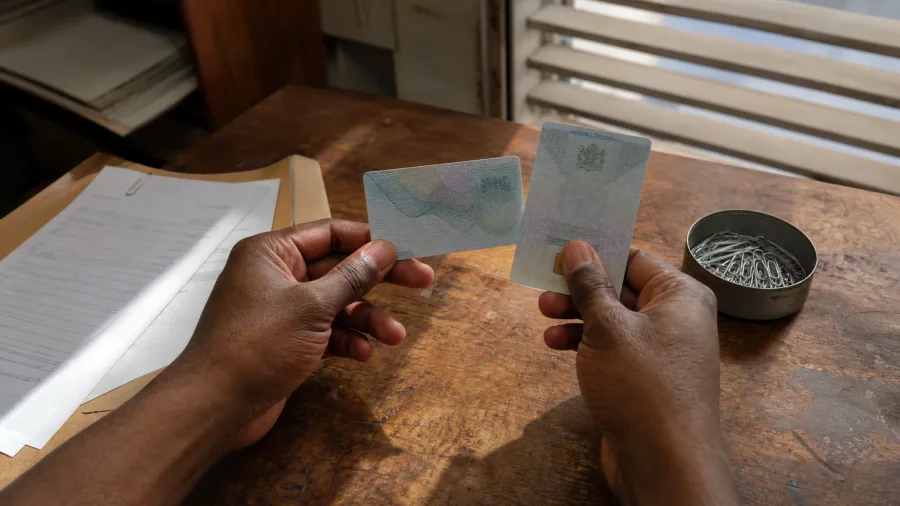
You are sitting across a desk, holding a card that looks exactly like the document people call a golden passport, and the officer is telling you it is not one. That is the moment the product changes shape in your hands: most island programs sell renewable residency, permission to live there on a clock, not a passport.
Three statuses sit in a row and you are almost always buying the first. Temporary or conditional residency, with conditions to keep; permanent residency, if the program offers a path to it; and citizenship, a separate application with its own conditions and a wait measured in years, if it exists at all. The card lets you live and work locally only as far as the program permits. Visa-free travel arrives on the passport and only after citizenship, and passing status to your children depends on the program's dependent rules.
So before you pay anything, read the official page and answer one question on paper: what does the card let us do, and what does it not? Naturalization conditions belong there too, in the program's own words, not an agent's.
🛂 From first payment to card in hand
Shortlist and verify
Read each island's official program page and record threshold, route and presence rules.
Assemble documents
Allow 6–10 weeks for statements, police checks, medicals and apostilles.
Pay application and due diligence fees
Expect roughly $12,000–$20,000 in legal and filing fees, plus $3,000–$6,000 per adult in checks.
Scouting trip
A five-day visit at about $2,500 for two lets you see the island and meet the lawyer.
Submit and wait
Government processing typically runs 4–10 months from first payment to card in hand.
Biometrics and collection
Budget a four-day return trip at about $2,000 for biometrics and document collection.
3. You may owe the island weeks per year

For the programs that do, the count is small on paper and large on a family calendar. A rule of fourteen days a year sounds like a long weekend you can fold around a school break. Run it out five years and it is seventy days spent on an island you may not otherwise have visited, and the card depends on every one of them.
At the other end, some programs ask nothing of your calendar at all: the card sits in a drawer and the obligation is the renewal fee and a fresh police certificate on the cycle the law sets. Between those poles sit the ones that write a number into statute. At thirty days a year, the honest planning figure is a hundred and fifty days over five years, and that is the number to hold up against school terms, a US job with limited leave, and the two trips you were already budgeting for scouting and biometrics.
Those totals are arithmetic, not program rules, and each island sets its own count and revises it. A figure borrowed from an agent's summary last year may already be stale. Before anyone books a flight or pays a filing fee, take the day count off the program's own government page, with the date attached, because the one number that quietly turns a cheap card into a five-year commitment is the one that governs how often you have to be there.
💡 Tip: Put the five-year day total on a calendar with your school holidays. If the two do not fit, that program is not for your family.
4. Spouse and minors ride along, parents cost extra

Answering "can the whole family come" takes ten minutes. Papering it takes months. That makes family scope the cheapest part of the decision to make and the most expensive to change later, once you have paid filing fees on the wrong list of names.
The spouse and minor children under 18 come in on the same application at no extra government charge, which is the generous part of every island program worth comparing. Adult children and parents are a second admission: roughly $15,000-$25,000 each, with the age cut-off for a dependent child set differently island to island, so check it on the government page, not the brochure. Every name on that list owes its own birth certificate, marriage certificate, police check and medical, and a divorce or a name change adds documents and weeks. Budget the second line and the second folder before you sign anything.
The invoice has line items the headline number hides
The qualifying investment is the figure the government advertises. It is rarely the figure you pay. Fees, due diligence checks, apostilles, two trips and — if you buy property — purchase taxes and annual holding costs stack on top before the card arrives.
Budget the whole invoice before you choose a program. A $350,000 budget that spends $39,500 on fees and travel is not a $350,000 budget; it is a $310,000 budget with a bigger story.
5. Fees and travel dwarf the advertised threshold
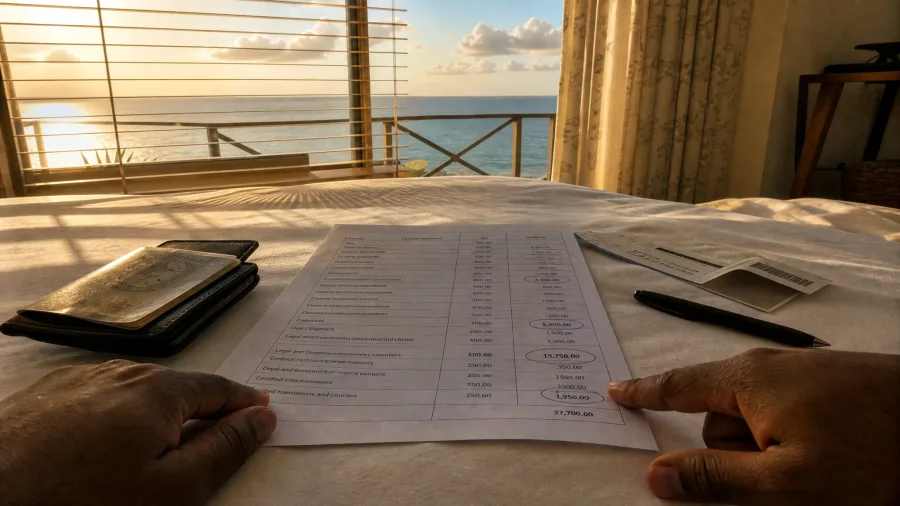
The invoice is not the investment.
Scope sets the bill: two adults and two children means two due diligence files at $3,000-$6,000 per adult, plus $12,000-$20,000 in legal and government filing fees, plus $1,500-$3,000 for apostilles, certified translations and couriers. Add the five-day scouting trip at about $2,500 and the four-day biometrics return at about $2,000 and the add-ons run $24,000-$39,500 before a single closing cost. On the property route, a $300,000-$400,000 two-bedroom carries 4-7% in purchase taxes and closing costs ($12,000-$28,000) and $3,000-$6,000 a year to hold, much like buying a house abroad. The headline figure is not the price, and the qualifying money may be locked away for years.
💡 Tip: Ask for the fee quote in writing, itemized, with the government fee separated from the lawyer's fee.
Where the money goes, low to high
Relative weight of each line on an island residency invoice
- Courier and translation: $1,500–$3,000 for apostilles, certified translations and couriers.
- Due diligence: $3,000–$6,000 per adult applicant, non-refundable in many programs.
- Legal and filing fees: $12,000–$20,000 quoted to the couple for the whole application.
- Property closing costs: 4–7% of purchase price, or $12,000–$28,000 on a $300,000–$400,000 condo.
- Annual holding costs: $3,000–$6,000 a year for management, insurance and HOA on island property.
6. A donation is sunk; a condo is sellable
Stand on the balcony of a two-bedroom on Grenada's south coast in the late afternoon and the trade wind carries salt and frangipani up off the garden, and the sea below is doing that flat turquoise thing it does before the sun drops behind the ridge. That is the picture the property route is selling. What the brochure photo never shows is a holding cost: $3,000 to $6,000 a year in management, insurance and HOA dues, paid whether or not you are standing on that balcony.
The donation route asks less of you and gives nothing back. It has the lower entry point, the lighter paper trail, and no asset to keep an eye on from four time zones away. What it does not have is a resale. The money is gone the day the application is approved, and the only thing you hold afterward is the card. For a household that wants the file closed and the card in a drawer, that is not a flaw. It is the point.
The property route is the reverse trade. You are buying a $300,000 to $400,000 two-bedroom condominium, and on top of the purchase price you pay 4 to 7 percent in purchase taxes and closing costs, then the annual holding cost above, and you cannot sell for however many years the program's law sets as its holding period. Fit turns on which loss you can live with: a sunk fee, or an asset with a calendar attached. Some islands run only one of the two routes, and some price them so differently that the cheaper option on paper is not the cheaper option once the fees land.
⚠️ COMMON MISTAKE
Selling too early can cost you the card
Every property route has a minimum holding period set in the program's law. Listing the unit before that period ends can put the residency itself at risk. Confirm the exact term on the official page before you talk to an agent.
7. Selling early can strand the asset

do not buy the condo unless you can leave the money in it for the full holding period, because a card tied to an asset sold too soon is a card at risk. The period is set in each program's law, differs island to island, and gets confirmed on the government's own page, never from an agent's summary slide.
Resale to another program applicant may need government consent, and island property can sit unsold for months with no public record of what comparable units actually fetched. List before the period ends and you may put the residency itself in question, with the consequence written in program law. That is fine for a family who wanted a place to use and a card to keep; it is wrong for anyone counting on liquidity inside five years, and they should take the donation route and stop pretending the condo is a savings account.
What actually sinks an application
Refusals rarely come down to the money. They come down to paperwork that does not explain where the funds came from, a record that should have been disclosed, or a file that sat long enough for the police certificates to expire.
The due diligence stage is where the clock stalls. Treat it as a writing project, not a form-filling exercise.
8. Source-of-funds paper decides most cases

Six to ten weeks. That is how long it realistically takes to assemble the statements, tax returns and proofs behind every dollar, and due diligence covers every applicant over 18 in the household, not just the earner.
The case that fails is almost never the one with too little money. It is the one with a large deposit nobody can trace, or a cash gift from a parent with no paper drawn up at the time. If a relative is helping fund the qualifying investment, get a short signed gift letter and a bank record of the transfer, stamped and dated, the week the money moves, not two years later when an officer asks. The paper behind a property sale or a crypto conversion needs the same treatment.
Fees are typically non-refundable if the application is refused, so this is the cheapest work you will do. Confirm the refund terms in the program's published documents before you pay a filing fee, and treat the due diligence file as the thing you build first, not the afterthought once the wire clears.
💡 Tip: Trace every dollar over about $10,000 to a document. If you cannot find the paper, the officer will not either.
What clears the check versus what blocks it
Clear documentation
- Six months of bank statements showing the source of every deposit.
- Contemporaneous gift letter with the wire record attached.
- Tax returns that match the reported income.
- Crypto and property sales with exchange or closing statements.
- Police certificates inside the validity window printed on them.
Red flags at due diligence
- Large cash deposits with no paper trail.
- A gift letter written months after the transfer.
- An undisclosed prior visa refusal.
- Stale police checks; the clock restarts.
- Any misrepresentation on the form itself.
9. Some records end the application outright

There is a particular silence in a government office corridor, fluorescent hum and cool air and your own footsteps, and it is the sound of waiting to learn whether a record from a decade ago is going to end this.
Some things paper can fix and some it cannot. A source-of-funds gap is solvable with a letter and a bank record; a criminal record, a prior immigration refusal, a sanctions match or a politically exposed person hit usually is not, and a misstatement on the form converts a fixable issue into a permanent one. Disclose a past refusal plainly rather than smoothing it over – concealment is treated worse than the underlying fact. The eligibility criteria sit on the government page, and a lawyer reading your own record before you file is worth the fee.
10. Six to ten months, mostly your own paperwork

Six to ten months is the realistic wait, and most of those months are yours, not the government's.
The timeline breaks down unevenly. Budget six to ten weeks to assemble, apostille and translate the document set for every applicant – birth and marriage certificates, police certificates, medicals, source-of-funds statements – and then four to ten months from the first payment to the card in your hand. The only stage the government controls is the review in the middle. The stage that drags is the family's own filing cabinet, the bank records and the tax returns you have to chase, the certificates you have to reorder from a county office that takes three weeks to mail one page.
Here is the trap that resets the clock. Police certificates and medicals carry a validity window, and the window is printed on the document by whoever issued it. If your file clears review but a police check has expired, the certificate must be redone – and a stale one can send the application back to the start of the queue, not the front. Confirm the validity windows for each document before you request them, and time the requests so they do not age out while the government reads the file.
Travel during processing is program-specific. Some islands want you present for biometrics and document collection; some ask for the passport to be submitted at a particular stage, which means no international travel until it comes back. Confirm both points with the official government unit before you book a single flight – not from an agent's promise. The four-day return trip you may have budgeted for only covers the collection stage, not a second submission.
Watch the timeline an agent quotes. Many quote only the government review window, a few months, and skip the weeks the family spends gathering paper. The honest planning number is the whole span, first payment to card, and the slow part is sitting in your own kitchen with a folder of statements.
💡 Tip: Order police certificates last, after everything else is apostilled, so they stay fresh through submission.
Island residency file — at a glance
💰 Qualifying investment
$300k–$400k property or donation route
🧾 Fees and travel
$24,000–$39,500 before closing costs
🏠 Annual holding
$3,000–$6,000 on a condo
⏱️ Time to card
4–10 months from first payment
👨👩👧👦 Dependents
Spouse and minors included; parents extra
🩺 Health cover
$6,000–$12,000 a year for a couple
First move
Pull source-of-funds paperwork before paying any agent a fee.
What daily life on the island actually costs and feels like
A card in a drawer and a real move are different purchases. If you plan to live on the island, the deciding facts are healthcare distance, flight connections, school terms and whether the program lets you work locally.
None of those questions are answered by an agent's brochure. Answer them on the scouting trip and in the program's own documents.
11. Flights, hospitals and few local jobs

The card arrives and the first thing you price is a flight home in an emergency. From most of these islands that means one stop, often two, through Miami or San Juan: a six-to-twelve-hour day door to door, and a return fare to the US running roughly $700 to $1,300 depending on season. Local hospitals are small and stabilize rather than treat, so the serious cases get flown out – which is why international cover for a couple quotes at $6,000 to $12,000 a year, not the few hundred you pay at home.
Then the two questions the brochure skips. Whether the card lets you work locally differs island to island, and it is worth asking the government unit directly before you assume a salary is possible. And the expat community – how big, how settled, how much of it leaves in hurricane season – is something you read on a scouting trip over coffee, not in an agent's deck. Medevac distance, school terms and work permission decide whether this is a real move or a card in a drawer, and only one of those is on the invoice.
12. Tax follows where you live, not the card
No, and the assumption that it will is the most expensive one in this whole exercise.
US citizens file US returns wherever they live. Holding an island residency card does not change that filing obligation by a single form, and no amount of island days removes it. The local side is a separate question with a separate answer, and the answer depends on two things: how many days you spend in that country, and what its own tax statute says. That is a matter for a licensed tax adviser in both countries, working from your actual income and your actual day count – not for an agent, and not for a residency consultant who has a fee riding on the answer.
Residents of the islands have a phrase for the pitch that residency equals tax freedom. The ones who have lived there a while just wait for the salesman to finish. Nobody who knows the law leads with it, because the law does not lead with it. The pitch is a walk-away signal – anyone who opens with tax freedom is selling the card, not reading you the statute.
So treat tax as a question you take to a professional, with the same seriousness you gave the source-of-funds paperwork. The card buys a legal status on an island. It does not buy an exemption from the country you already pay.
💡 Tip: Ask a tax adviser in writing whether your planned days on the island trigger local tax residence under that country's rule.
Frequently Asked Questions
Is buying residency on an island worth it?
It depends on what you want the card to do. If you need a base, a place to hold property and a path that may lead to citizenship years out, the math can work. If you want a passport next year, it will not. Measure the all-in cost — $24,000–$39,500 beyond the investment in the case here — against what the card actually unlocks.
Can I include my parents or adult children?
Spouse and minor children typically ride on the same application. Parents and adult children are usually a separate addition at roughly $15,000–$25,000 each, and the age cut-offs differ by island. Budget a second document set and a longer timeline.
How long until I have the card in hand?
Plan for 4–10 months from first payment. The first 6–10 weeks are your own document assembly, which is usually the slow part. Police certificates and medicals that expire inside the processing window send the file back to the start.
Do I have to live on the island to keep residency?
Some programs have no stay requirement; others count days per year for renewal or naturalization. Confirm the current rule on the official government page for the island you are considering, because the number changes and it is set in law.
Will this reduce my US taxes?
No. US citizens file US returns wherever they live. The local tax position depends on days present and that country's statute, and it needs a licensed adviser in both countries. An agent promising tax freedom is a signal to walk away.
Buy the Passport You Will Actually Use
Settle it by who you are. If you want it finished and never thought about again, take the donation route and accept the money is gone. If you want something sellable, take the property route, budget the closing costs and the annual holding costs, and accept the holding period before you sign. If you cannot spare weeks on an island, pick a program with no stay requirement, confirmed on the government page.
Every one of them starts the same way: pull your source-of-funds paperwork together and read that island's official program page before paying any agent.
The podcast number was never the price. The price is fees, calendar, family scope and exit terms. And what you are buying has a paper trail and a clock on it. So start where this began, at the numbers people skip past, and use the headline only as the first line of the invoice.
Before you pay the retainer, check the official page
Open the government unit's program page, note the current threshold and presence rule with today's date, then compare it to the fee quote in front of you.